
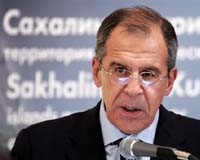
Russian Foreign Minister Sergei Lavrov on Monday made a new pitch for a system of collective European security that would ensure security for all.
He said the current security architecture "proved to be insufficient and flawed," citing as evidence NATO's decade-long eastward expansion into former Soviet republics or allies and the recent Caucasus conflict.
He told a press conference on the sidelines of the UN General Assembly session that principles underpinning collective European security were still valid but were not being respected.
"Those principles speak of sovereignty, territorial integrity, non-interference in internal affairs of states," Lavrov noted. "Most importantly it speaks about indivisibility of security and speaks of the need to avoid any means to strengthen your own security at the expense of the security of others," he noted.
The security principle "has been under permanent strain in the last years," Lavrov said, pointing to NATO's eastward expansion, "combined with moving military assets of NATO in the territories of the new members."
Moscow had bitterly opposed NATO's expansion since the first round in 1999 but ultimately accepted the addition of former Soviet bloc countries and the Baltic states and even entered into a relationship with NATO, once its arch foe.
Lavrov also slammed the US arming of Georgia, "including by covert means," saying it had emboldened Tbilisi to launch its offensive against separatists in the rebel enclave of South Ossetia.
Russian troops counter-punched and routed Georgian troops in a five-day blitz across South Ossetia, setting up positions deep inside Georgian territory.
Moscow subsequently announced it would withdraw troops to Georgia's rebel South Ossetia and Abkhazia enclaves.
Lavrov also said the new security system proposed by Russian President Dmitry Medvedev in Berlin last June should involve the OSCE, NATO, the EU and "the security structure of the post-Soviet space."
In his speech to the General Assembly Saturday, the top Russian diplomat called for a "pan-European summit" that would be tasked with developing "a treaty on European Security, a kind of 'Helsinki-2'."
The Helsinki accords were signed by 35 states in the Finnish capital in 1975 in a bid to improve relations between the Moscow-led communist bloc and the West.
