
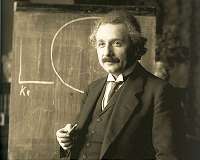
Dozens of new manuscript pages composed by Albert Einstein were unveiled at the Hebrew University of Jerusalem in Israel on Wednesday. The new collection of documents also features several letters and notes penned by the famed scientist.
Einstein, winner of the 1921 Nobel Prize in Physics, is perhaps best known for his general theory of relativity, which transformed particle physics and cosmology, but his discoveries in the field of physics were many. His theories inspired the creation of lasers, nuclear power, fiber optics and many more technologies still in use today.
Einstein was also instrumental in the founding of the Hebrew University of Jerusalem, which houses the physicist's archives — archives that now feature a new collection.
"We at the Hebrew University are proud to serve as the eternal home for Albert Einstein's intellectual legacy, as was his wish," Hanoch Gutfreund, archives director and professor at the university, said in a news release.
The new collection features 84 manuscript pages containing mathematical derivations written between 1944 and 1948. Many of the research notes and calculations lack context, but nonetheless offer insights into the scientist's thinking. The collection also includes an unpublished appendix to a scientific paper describing the physicist's "unified theory," one of many attempts by Einstein to describe all the forces of nature with a single theory.
In addition to scientific notes, Hebrew University archivists unveiled several letters written by Einstein to his close friend and fellow scientist, Michele Besso. The letters feature Einstein's thoughts on religion, politics and family matters, among other subjects. Another document in the new collection, a 1935 letter addressed to his son Hans Albert, reveals Einstein's growing worries about the rise of the Nazis and Europe's geopolitical instability.
The new documents were purchased from a private collector in North Carolina using funds from a philanthropic gift provided by the Crown-Goodman Family Foundation.
Researchers are currently working on digitizing the documents, as well as providing context to the scientific notes and mathematical formulas.
