
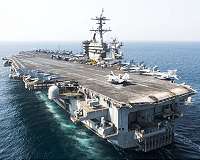
A U.S. Navy technological innovation that makes landing fixed-wing aircraft on an aircraft carrier easier was tested aboard the USS George Washington in the past week.
The Maritime Augmented Guidance with Integrated Controls for Carrier Approach and Recovery Precision Enabling Technologies, better known as Magic Carpet, is technology designed to streamline the carrier landing process, the Navy said in a release.
The software provides improved safety, efficiency and success rates in recovering fixed-wing aircraft on aircraft carriers.
The Strike Air Test and Evaluation Squadron conducted the tests.
On typical carrier landings, a pilot must align glide slope, angle of attack and line up, often requiring hundreds of individual adjustments to land safely.
Magic Carpet seeks to reduce the pilot's workload during the landing process.
"With the technology, we decoupled the glide slope, angle of attack and line up into three separate pieces," said Capt. David Kindley, the F/A-18 & EA-18G program manager. "Before, if a pilot made one small change to any of these it would affect all the other things. With Magic Carpet, if the pilot wants to adjust glide slope, he just pushes the stick without changing the power or anything else."
The initial version of the software was tested last year on the USS George H.W. Bush.
The finalized version of the technology is expected to come out in 2019.
Keel authenticated for LCS Charleston
Mobile, Ala. (UPI) Jun 29, 2016 –
Austal USA celebrated the keel authentication of the future USS Charleston, the ninth Independence-variant littoral combat ship, at a ceremony in Mobile, Ala., Tuesday.
Built by an industry team lead by Austal, the Charleston will be about 421 feet long and feature a width of 104 feet, a Naval Sea Systems Command release said.
The LCS is a modular ship that can be equipped with surface warfare, mine countermeasure and anti-submarine warfare mission packages.
The ships feature the Independence variant, led by Austal, and the Freedom variant, led by Lockheed Martin.
The LCS program has been plagued by years of cost overruns and issues with design and survivability.
A plan was announced in 2014 to limit LCS production to 32 ships instead of the 52 originally planned.
Officials decided the gap would be filled with a multi-mission frigate. The LCS/frigate program was further winnowed to 40 vessels in December due to concerns about the sea service's balance between capability and quantity of platforms, the report states.
But while intended as a counter for the LCS issues, a GAO report released this month questions the frigate's future as well.
This month's GAO report is the latest in a long line of criticism against LCS, which was intended to be a highly mobile and modular surface vessel.
"Since 2005, we have raised many concerns about the Navy's acquisition of LCS, including its combat effectiveness and decreased expectations of its capability," the report notes. "Most recently, in December, 2015, we concluded that the lethality and survivability of LCS is still largely unproven, and that important questions remain about how LCS will operate and what capabilities it will provide the Navy."
