
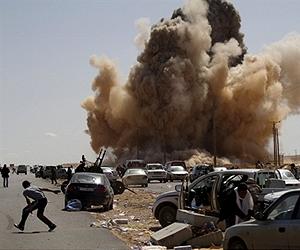
NATO said Tuesday it has stepped up a psychological campaign to force Moamer Kadhafi's troops to surrender their arms and return home by broadcasting radio messages and air-dropping leaflets.
The messages also encourage pro-Kadhafi troops and civilians to stay away from military installations being targeted for air strikes, said Wing Commander Mike Bracken.
"Since the start of operations we have been encouraging pro-Kadhafi forces to lay down their arms," Bracken told reporters nearly seven weeks after NATO took over the air war from a US-led coalition.
"Just recently we have stepped up these activities by distributing leaflets and using airborne radio systems to tell Kadhafi forces to move away from any military equipment including aircraft, vessels, vehicles and infrastructure," he said.
The Kadhafi troops are encouraged to "return to their barracks and homes," Bracken said via videolink from the NATO operation's headquarters in Naples, Italy, adding that some 140,000 leaflets have been dropped by aircraft so far.
earlier related report
Libya misses chemical weapons deadline: watchdog
Tallinn (AFP) May 17, 2011 –
Libya has requested more time to destroy its stockpile of chemical weapons after missing a deadline, an international monitoring group said on Tuesday.
Ahmet Uzumcu, the director-general of the Organisation for the Prohibition of Chemical Weapons (OPCW), told delegates at a conference in Estonia that the situation in Libya was a "particular concern" for the watchdog which was now considering whether to grant the extension.
"This country has requested an extension of its destruction deadline, which expired yesterday and the issue is currently being considered by the executive council," Uzumcu saidd.
In March, an OPCW spokesman confirmed that 55 percent of Libya's mustard gas stockpile had been destroyed while 11.25 tonnes of the substance were still awaiting destruction.
But Tripoli had destroyed the munitions required to use this chemical weapon, according to reports.
Libya joined the United Nations affiliated OPCW in January 2004 when veteran leader Moamer Kadhafi vowed to destroy stockpiles of mustard gas, a weapon causing severe chemical burns to the skin, lungs and eyes, used by Germany during World War I.
Tripoli committed itself to destroying its chemical weapons stockpiles under the terms of the OPCW-administered Chemical Weapons Convention an arms control deal ratified by 188 states which outlaws the production, stockpiling and use of chemical weapons.
According to Uzumcu, to date, "65 percent of the world's declared chemical weapons stockpiles have already been verifiably destroyed."
"The destruction of the remaining stockpiles by the final deadline of April 2012 remains a challenge," the OPCW head added.
"But whereas the general risk of the use of chemical weapons by states has been almost eliminated, there remains the possibility of the use of chemicals by non-state actors."
Since the Chemical Weapons Convention entered into force in April 1997, OPCW inspection teams have conducted inspections at over 2000 industrial units in more than 80 countries.
The OPCW's Tallinn meeting, which has drawn delegations from 23 states, ends Wednesday.
It was not immediately clear what sanctions were open to the OPCW if the organisation turns down Libya's request.
Share This Article With Planet Earth
