
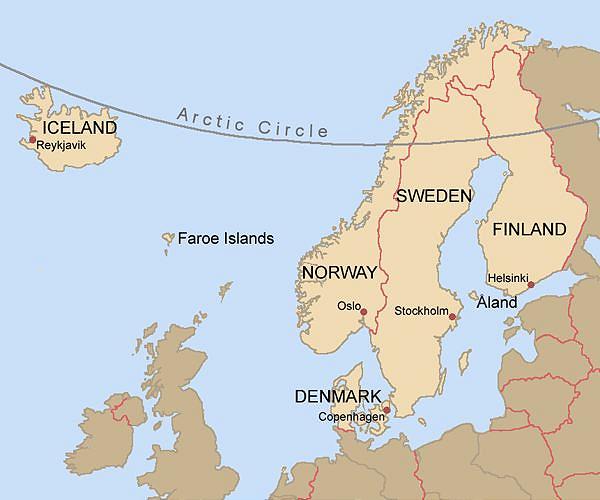
NATO has no current plans to send troops to Sweden and Finland once they complete the membership process launched this week, the defensive alliance's deputy chief told AFP Tuesday.
"We don't plan to have an additional presence in either country, they have formidable national forces. They're capable of defending themselves," Deputy Secretary General Mircea Geoana said in a telephone interview.
Russian President Vladimir Putin warned last week that "if military contingents and military infrastructure were deployed there, we would be obliged to respond symmetrically and raise the same threats for those territories where threats have arisen for us".
Geoana said that "we don't plan to have NATO bases in these two countries, because they have a very high level of military and strategic maturity".
After the accession process was launched Tuesday, it is up to parliaments in all 30 member states to ratify Oslo and Helsinki's membership of the Atlantic alliance.
Although a deal has been struck in principle with Turkey to overcome its objections relating to the Nordic countries' policy towards Kurdish militants, there is still some suspense on whether Ankara will ratify immediately.
"We hope the process will be completed quickly," Geoana said, saying "many countries have already launched" steps towards ratification — although he declined to lay out a precise timetable.
Also speaking Tuesday, NATO Secretary General Jens Stoltenberg said: "I count on allies to deliver a quick and swift and smooth ratification process."
Geoana hailed NATO members' and allies' support for Ukraine as it defends itself against the Russian invasion launched on February 24.
But he acknowledged "active concerns" about how long the flow of arms and ammunition can be kept up.
Although information exchange about Ukraine's needs "is working very well… there is of course the problem of reserves in allied countries," Geoana said.
Military stocks are limited in European countries, many of which lack the industrial capacity to quickly ramp up arms production for the long haul.
But "there is an effort to boost capacity and creativity from the manufacturers, it's been working very well so far," Geoana said — recalling also that Western leaders have repeatedly stated a determination to support Ukraine for the duration.
"Everyone was aware that we'll have strategic patience" at June's NATO summit in Madrid, he added.
But as the fallout from the war hits energy, food and financial markets, observers have warned that national leaders may face growing public opinion and funding constraints.
NATO launches membership process for Sweden, Finland
Brussels (AFP) July 5, 2022 –
NATO on Tuesday kicked off momentous accession procedures for Sweden and Finland, aiming to expand the military alliance to 32 countries in reaction to Russia's war in Ukraine.
"This is an historic day, for Finland, for Sweden, for NATO, and for Euro-Atlantic security," NATO chief Jens Stoltenberg said after protocols were signed launching the required ratification process in all alliance countries.
The foreign ministers of Sweden and Finland, alongside Stoltenberg, also qualified the occasion as "historic".
"The membership of both Finland and Sweden will not only contribute to our own security, but to the collective security of the alliance," said Finland's Pekka Haavisto.
The two Nordic countries had long maintained non-alignment status, even though they have held exercises with NATO and have inter-operable weapons systems.
They announced intentions to join NATO in May, triggered by Russia's February invasion of Ukraine and ongoing war there.
In a sudden change of course, Sweden and Finland — the latter of which fought a Soviet invasion in 1939-1940 and shares a 1,340-kilometre (830-mile) border with Russia — asked to come under NATO's mutual-defence umbrella.
Their bids hit a road-bump when Turkey, a NATO member, threatened to block their entry.
Turkish President Recep Tayyip Erdogan had accused Sweden and Finland of being havens for Kurdish militants he has sought to crush, and for promoting "terrorism".
He also demanded they lift arms embargoes imposed for Turkey's 2019 military incursion into Syria.
But Erdogan dropped his objections last week, in time for a NATO summit in Spain, after negotiations resulted in concessions — and a US promise of new warplanes for Turkey.
The summit ended up extending invitations to Sweden and Finland to formally apply, leading to lightning-fast negotiations on Monday then Tuesday's signing.
– Security commitments –
Erdogan says he could still slam the door shut if Sweden and Finland don't follow through on their promises, which include possible extradition agreements.
The months-long period during which all NATO countries have to ratify the Nordic countries' membership is a risky moment, not only because of Turkey's threat but also because the NATO mutual-defence clause is not yet applicable.
Sweden's Prime Minister Magdalena Andersson told reporters in her country that Stockholm figured legislative approval from NATO nations "could take a year, and that estimation rests".
Stoltenberg said: "I count on allies to deliver a quick and swift and smooth ratification process."
He emphasised that "many allies have already made clear commitments to Finland and Sweden's security" during the interim period, and pointed out a boosted NATO presence in their region.
Swedish Foreign Minister Ann Linde said security assurances had been made by the United States, Britain, France, Germany, Spain, Italy, Poland and NATO members in the Nordic and Baltic regions.
Several NATO members flagged expedited ratification for Sweden and Finland.
"Moments after Finland and Sweden's accession protocols were signed in Brussels, I summoned my government and proposed to Estonian parliament to convene tomorrow for accelerated ratification," Estonian Prime Minister Kaja Kallas tweeted.
Germany's parliament was poised to ratify as early as the end of this week. Sources in the ruling coalition said a first reading of the text was likely on Wednesday, with the final two readings on Friday.
"This is the fastest accession process in NATO's history so far," Stoltenberg said.
