
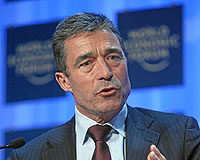
NATO chief Anders Fogh Rasmussen came to the defense Wednesday of efforts to bring stability to Afghanistan, amid mounting criticism of military operations and fraud-tainted elections.
"In many countries people are impatient. I'm impatient myself. I also want more rapid progress on the ground," Rasmussen said, attending a ceremony in the United States for the first non-American to become a NATO supreme commander.
"The Taliban has no chance of taking power again, nor do terrorists have any safe haven in Afghanistan from which to threaten the world. Afghans are slowly but steadily leading better, freer lives.
"And while the elections have clearly not been close to perfect, in the context, they were still a step forward," he said, accepting that while Afghans did have quality of life improvement, it was a question of "slowly but surely".
Regarding civilian victims of the conflict Rasmussen told AFP that the implementation of a new strategy had led in 2009 to a "reduction, a meaningful one, by 95 percent of civilian deaths compared to last year."
Earlier Wednesday, leading challengers for the Afghan presidency claimed massive fraud had compromised the August 20 polls, raising questions about the legitimacy of Hamid Karzai's expected second term in office.
The president passed the key threshold of an outright majority based on results from more than 90 percent of polling stations, which put the war-torn and corrupt country on track for five more years of Karzai rule.
Western allies, who have sent more than 100,000 soldiers to fight the Taliban-led insurgency and back the government, have condemned the fraud during Afghanistan's second presidential election.
Those foreign governments are facing increasingly hostile public opposition to the war effort, particularly due to record international fatalities as their troops stepped up combat in July.
Rasmussen also threw his weight Wednesday behind a proposal from Britain, France and Germany for an international conference on Afghanistan later this year to help Afghans take more responsibility for their own future.
He was speaking in Norfolk, Virginia where French air force general Stephane Abrial became the first NATO supreme commander from outside the United States.
Abrial took over from James Mattis — a marine general who heads US Joint Forces Command (USJFCOM) — as Supreme Allied Commander Transformation, one of NATO's two overall strategic command positions.
Share This Article With Planet Earth
