
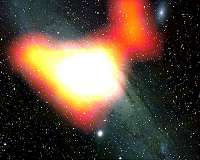
NASA's Fermi Gamma-ray Space Telescope has found a signal at the center of the neighboring Andromeda galaxy that could indicate the presence of the mysterious stuff known as dark matter.
The gamma-ray signal is similar to one seen by Fermi at the center of our own Milky Way galaxy.
Gamma rays are the highest-energy form of light, produced by the universe's most energetic phenomena.
They're common in galaxies like the Milky Way because cosmic rays, particles moving near the speed of light, produce gamma rays when they interact with interstellar gas clouds and starlight.
Surprisingly, the latest Fermi data shows the gamma rays in Andromeda – also known as M31 – are confined to the galaxy's center instead of spread throughout.
To explain this unusual distribution, scientists are proposing that the emission may come from several undetermined sources.
One of them could be dark matter, an unknown substance that makes up most of the universe.
New dark matter detector in a race to finish line
The race is on to build the most sensitive U.S.-based experiment designed to directly detect dark matter particles. Department of Energy officials have formally approved a key construction milestone that will propel the project toward its April 2020 goal for completion.
The LUX-ZEPLIN (LZ) experiment, which will be built nearly a mile underground at the Sanford Underground Research Facilit … read more
