
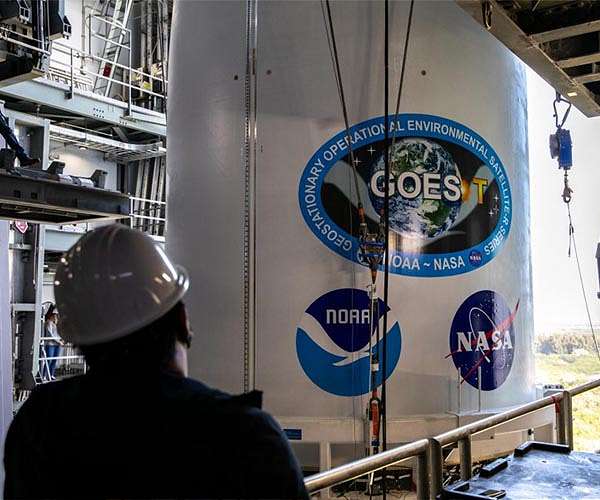
NASA plans to launch the latest in an advanced series of weather satellites, the GOES-T, from Florida on Tuesday to improve weather forecasting over the Pacific and western United States.
United Launch Alliance's Atlas V rocket is prepared for liftoff during a two-hour window starting at 4:38 p.m. EST from Complex-41 at Cape Canaveral Space Force Station.
Meteorologists around the world are looking forward to better data from the newest weather satellite, which will feed data to the National Oceanic and Atmospheric Administration and other U.S. agencies.
"I am paying a lot of attention to the GOES-T launch," Tim Schmidt, a NOAA research satellite meteorologist based in Wisconsin, told UPI in an email.
"It will be a very exciting day. I can't wait for the new GOES-18 data to arrive," he said.
There is a 30% chance that clouds or lightning could prompt a postponement of the launch, according to a U.S. Space Force forecast. A similar launch time in case of delays is planned for Wednesday.
Once it launches, the satellite will be known as GOES-18 and will be positioned to monitor Alaska, Hawaii, Mexico, Central America and the Pacific Ocean, as well as western states.
"This is the third in this new advanced series," Schmidt said. "The instruments are similar to previous spacecraft, but this will help provide the continuity of observations that we all need."
One notable feature, he said, is the satellite's ability to monitor most of the Western hemisphere at a large scale, while still being able to hone in on regional phenomena like wildfires, storms and volcanoes.
Such capability will allow forecasters to make better long-term and short-term forecasts, he said.
