
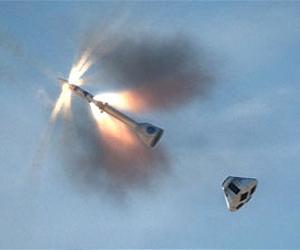
The US space agency NASA successfully tested an emergency abort system for the space shuttle's successor, Orion, Thursday at a remote test site in the New Mexico desert.
The emergency system used powerful rocket motors to blast the crew module off the launch site, shooting it 1.2 miles (1.9 kilometers) into the air in six seconds at high rates of speed, then wafting it back to Earth on a parachute.
"This system is much more advanced in capability and technology than any abort system designed in the past," said Doug Cooke, a NASA associate administrator for the Exploration Systems Mission Directorate based in Washington.
"NASA strives to make human spaceflight as safe as possible, and what we learned here today will greatly contribute to that goal," he said in a statement after the launch.
The space agency said the test lasted 135 seconds from launch to touchdown a mile (1.6 kilometers) north of the launch pad at the US Army's White Sands Missile Range.
An abort motor, powered by three rockets, unleashed a half-million pounds of thrust to lift the craft at a rate of 445 miles per hours (720 kilometers per hour) in the first three seconds.
Steering the module on its upward trajectory was a second motor that fired simultaneously with the abort motor, using eight thrusters to produced 7,000 pounds of thrust.
When the abort motor burned out, a third motor ignited to separate the module from the abort system before deploying a parachute.
NASA said it was the first US-designed abort system of its kind to be tested since the iconic Apollo generation space vehicles.
The Orion capsule, originally designed to take astronauts back to the moon, is a surviving component of the Constellation manned space exploration program cancelled by President Barack Obama in February for being behind schedule and over budget.
The aging US space shuttle fleet, which carries astronauts to the International Space Station, is due to be grounded at the end of the year, leaving US astronauts to hitch rides on Russian spacecraft to orbiting station until a replacement is developed.
Unlike the shuttles, the Orion capsule would be launched into space on top of a rocket.
Orion is now being considered as an escape module for the ISS so US astronauts do not have to rely on Russian craft for a return to Earth.
Share This Article With Planet Earth
