
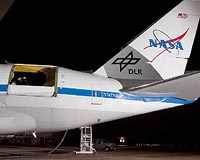
NASA issued a Request for Information (RFI) Monday soliciting potential partners interested in using the Stratospheric Observatory for Infrared Astronomy (SOFIA) aircraft for scientific investigations or for other potential uses.
NASA's Fiscal Year 2015 budget request to Congress calls for SOFIA to be placed in storage next year unless the agency's contribution to the project can be replaced.
Various partnership levels will be considered. Partnerships can range from joining as a major partner to securing flights on a night-by-night basis. Costs are estimated at approximately $1 million per night for a dedicated mission. Due to the current budget situation, partnership arrangements would be initiated immediately in order to be in place prior to Oct. 1. Potential partners are invited to submit their interest or questions in writing as soon as possible, but prior to May 1.
The SOFIA team will conduct an Industry Day April 11 at NASA's Armstrong Flight Research Center Bldg. 703 in Palmdale, Calif., to provide detailed information to potential partners and the media. Representatives can meet with the SOFIA program staff and take a tour of the aircraft. A number of briefings will be given on SOFIA's science program, the aircraft, its operational and life-cycle costs, as well as potential partnership mechanisms.
SOFIA is the world's largest airborne astronomical observatory, complementing NASA's space telescopes, as well as major Earth-based telescopes. It features a German-built far-infrared telescope with an effective diameter of 100-inches (2.5 meters). The telescope weighs 19 tons (38,000 lb.) and is mounted in the rear fuselage of a highly modified Boeing 747SP aircraft.
Flying at altitudes of between 39,000 to 45,000 feet (12 – 14 kilometers) and above 99 percent of the water vapor in the atmosphere, SOFIA facilitates observations that are unobtainable from telescopes on the ground. Because SOFIA can fly virtually anywhere in the world, change instruments between flights, and implement new capabilities, it provides greater adaptability than any space-based telescope.
