
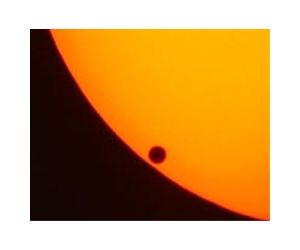
The public is invited to a free lecture being held at the Library of Congress, about the rare Venus transit event.
On June 5, 2012, the planet Venus will move across the face of the sun. Such transits of Venus are among the rarest of planetary alignments, and they come in pairs that are eight years apart but separated by more than a century. "Only six such events have occurred since the invention of the telescope," said NASA astrophysicist Sten Odenwald, at NASA's Goddard Space Flight Center, Greenbelt, Md.
Odenwald will discuss "A Rare Astronomical Event: Transit of Venus" at 11:30 a.m. EDT on Tuesday, May 8, in the Mary Pickford Theater on the third floor of the James Madison Building, 101 Independence Ave. S.E., Washington, D.C. The event is free and open to the public. Tickets are not needed.
The illustrated lecture, the third in a series of programs in 2012, is presented through a collaboration between the Library's Science, Technology and Business Division and NASA Goddard. The collaboration is in its sixth year.
According to Odenwald, transits of Venus inspire public fascination and scientific activity. Historically, this rare alignment is how scientists have measured the size of our solar system, specifically the distance between the Earth and the sun, which is now identified as the "astronomical unit."
During the 1761 transit, observers noticed a fuzzy halo of light surrounding the dark spot of Venus, visible only when Venus was at the sun's edge. Scientists of the time concluded that Venus must have an atmosphere, and later scientists confirmed that it does: a dense atmosphere of mainly carbon dioxide with clouds of sulfuric acid.
Odenwald is an astrophysicist at the NASA Goddard Space Flight Center and senior scientist with ADNET Systems, Inc. He received his doctoral degree from Harvard University in 1982, and has been involved with investigations of star formation, galaxy evolution and the nature of the cosmic infrared background. He is a book author and writes articles for magazines.
Odenwald participates in many NASA programs in space science and math education and has appeared on National Geographic TV specials. He is currently chronicling the historical impact on humans of space weather such as solar storms.
