
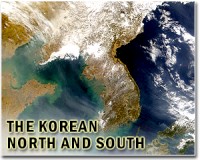
North Korea on Saturday warned South Korea of "merciless retaliatory strikes", a day after the South fired warning shots at North Korean boats near their disputed sea border.
The North's military General Staff said from now on it would open fire without warning at any South Korean ships if they intrude "even 0.001 millimetres" into disputed waters in the Yellow Sea.
It called for the South to apologise for the "reckless military provocation", which it said aimed to "drive the situation in the volatile hotspot to the brink of explosion".
"From now on, we will open direct fire on any warship of the South Korean puppet forces without warning, if it intrudes… even 0.001 mm in the hotspot of the West Sea," it was quoted as saying in a statement carried by Pyongyang's Korean Central News Agency (KCNA).
"They should be mindful that they would face our merciless retaliatory strikes anytime and at any place and in any way", it added.
It accused the South of responding to its efforts to create dialogue with "reckless military provocation".
In recent weeks, Pyongyang has been urging Seoul to accept leader Kim Jong-Un's proposal for military talks aimed at easing cross-border tensions.
Seoul has flatly rejected the offer, insisting that the North should first take a tangible step towards ending its nuclear weapons programmes.
A South Korean naval vessel fired warning shots Friday after a patrol boat from the North and a fishing boat crossed the disputed sea border. The North's boats swiftly retreated.
"This reckless military provocation was evidently prompted by a premeditated sinister plot to bedevil the north-south relations and further aggravate the tension on the Korean peninsula", KCNA said.
Both sides complain of frequent incursions by the other and there were minor naval clashes in 1999, 2002 and 2009.
EU further tightens sanctions on North Korea
Brussels (AFP) May 27, 2016 – The European Union on Friday further tightened sanctions against North Korea over nuclear and ballistic missile tests carried out in defiance of UN Security Council resolutions.
The 28-nation bloc said it adopted new restrictions in the trade, financial, investment and transport sectors in order to complement UN resolutions against the Democratic People's Republic of Korea, the north's official name.
"The EU decided to further expand its restrictive measures targeting the DPRK's nuclear, weapons of mass destruction and ballistic missile programmes," according to a statement from the European Council, which groups EU member states.
It cited the "grave threat to international peace and security in the region and beyond" that North Korean actions pose.
Under the new measures, the EU bans imports of petroleum products and luxury goods from North Korea as well as the sale or transfer to the regime of any civilian material or equipment that can also be used for military purposes.
It also prohibits any financial support for trade with the regime as well as any North Korean investment in the European bloc.
EU nationals and entities are barred from investing in the mining, refining and chemical industries sectors as well as in any entities working on illegal programmes.
The bloc also bans any North Korean aircraft from landing in or taking off from EU territory or even flying over it. And it prohibits any vessel owned, operated or crewed by North Korea from entering EU ports.
Last week the bloc added 18 persons and one entity to its asset freeze and travel ban blacklist, meaning sanctions are now in place against 66 individuals and 42 entities in North Korea.
In March, the UN Security Council imposed the toughest sanctions yet against Pyongyang, including unprecedented inspections of all cargo to and from the notoriously reclusive country which has locked itself away from the rest of the world for the past 60 years.
The UN sanctions also banned or restricted exports of coal, iron and iron ore and other minerals, along with the supply of aviation fuel as part of efforts to get Pyongyang to abandon its nuclear and missile ambitions.
The EU established diplomatic relations with North Korea in 2001 but contacts are minimal. It adopted its first sanctions in 2006.
