
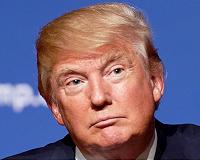
North Korea's foreign minister has brushed aside US President Donald Trump's fiery threat to destroy his nation, comparing it to a "dog's bark" and suggesting Pyongyang would not be deterred by the rhetoric.
Trump used his stormy maiden address at the United Nations General Assembly Tuesday to warn the North that Washington would "totally destroy" it if the US or its allies was attacked.
The bellicose speech came after months of escalating tensions over advances in the rogue weapons programme operated by Pyongyang, which has defied tough sanctions to launch its sixth and largest nuclear test and to fire a series of missiles over Japan.
Arriving in New York for the UN meetings, North Korean Foreign Minister Ri Yong-ho was mobbed with questions from reporters about the Trump speech and replied with a proverb.
"There is a saying that marching goes on even when dogs bark," he said as he entered his hotel on Wednesday.
"If they are trying to shock us with the sound of a dog's bark they are clearly having a dog dream."
Isolated and impoverished, the North says it needs a sturdy nuclear deterrence to protect it from an aggressive US and the autocratic regime has made militarism a central part of its national ideology.
Pyongyang's stated aim is to be able to target the US mainland and the nation has flaunted the advances in its weapons programme in recent weeks, with the September test of what it said was a miniaturised H-bomb capable of being loaded onto a rocket.
The country also tested two intercontinental ballistic missiles in July that appeared to bring much of the US mainland into range.
The increasingly brazen provocations have frayed the patience of the US and its allies.
Trump dubbed the North's leader Kim Jong-Un "Rocket man" and said he was on a "suicide mission".
A day later Japan's Prime Minister Shinzo Abe told the UN that dialogue with the North would not work.
The comments are likely to dismay China — the North's only major ally and trading partner — which has consistently called for a resumption of talks.
Observers say that despite the tough rhetoric, any military response to the crisis would risk a devastating conflict that would imperil millions.
The North has fortified its southern frontier with a hefty arsenal of artillery that has the South's capital Seoul, just 55 kilometers (35 miles) away, in its sights.
Japan is also within range of missile strikes, while the North itself has a population of millions ensnared by the Pyongyang regime.
No need to renegotiate Iran nuclear deal: EU
United Nations, United States (AFP) Sept 21, 2017 –
EU foreign policy chief Federica Mogherini said Wednesday that there was no need to renegotiate the Iranian nuclear deal, insisting it was "delivering" despite US demands to re-open the agreement.
"There is no need to renegotiate parts of the agreement because the agreement is concerning a nuclear program and as such is delivering," Mogherini told reporters following a UN meeting of the six powers that negotiated the deal with Iran.
"We have all agreed that all sides are implementing so far the agreement," she said.
US Secretary of State Rex Tillerson joined Iranian Foreign Minister Mohammad Javad Zarif for a first meeting with partners backing the 2015 deal that provides for sanctions relief in exchange for curbs on Tehran's nuclear program.
Trump is due to report to the US Congress by October 15 on whether he can certify that Iran is upholding its side of the accord, under which it accepted limits on its nuclear program.
In his address to the UN General Assembly, Trump on Tuesday called the nuclear deal "an embarrassment" for the United States and Tillerson later confirmed that the agreement must be "revisited."
But Mogherini, who chaired the meeting, argued that it would be unwise to re-open the deal at a time when the world is facing a nuclear threat from North Korea.
"We already have one potential nuclear crisis. We definitely do not need to go into another one," she said.
Other than Iran and the United States, the other signatories of the accord are Britain, France, Russia, China and Germany.
Trump's North Korea talk 'counterproductive': analysts
With his threats to "totally destroy" North Korea, Donald Trump is playing into Pyongyang's hands by offering justification for a nuclear weapons programme it insists is for self-defence, analysts say.
The US leader used his maiden speech at the UN General Assembly to deliver a blistering warning to Pyongyang, after it tested its sixth and largest nuclear bomb and responded to new sanctions … read more
