
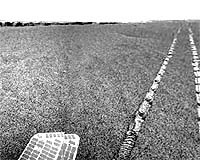
Opportunity completed the first leg of a two-part drive toward an area of scientific interest known as "Gilbert" that involved moving backward in order to continue the drive without running into some unexpectedly deep soil to the rover's right. En route, Opportunity spent two Martian days acquiring compositional data from a rock exposure dubbed "Lyell-Exeter," measured argon gas in the Martian atmosphere, and conducted remote-sensing activities.
In addition, Opportunity tested relay communications in support of NASA's Phoenix mission, due to land on Mars in late May. The first test, with the European Space Agency's Mars Express spacecraft, took place on sol 1444 (Feb. 15, 2008) and was primarily a trial of a new command strategy to permit the orbiter to acquire a larger amount of data from the surface of Mars.
The second test was a possible relay through the NASA's Mars Reconnaissance Orbiter on sol 1446 (Feb. 17, 2008). This was an attempt to take advantage of an anomaly on the orbiter that turned off science instruments and placed the orbiter on standby to await instructions from Earth. The recovery timeline ended up not supporting this particular test.
The third, with Mars Express on sol 1449 (Feb. 20, 2008), was part of a series of tests to determine differences in performance when the orbiter receives data from directly overhead and when the orbiter receives data when not directly overhead.
Opportunity remains healthy, with all subsystems performing as predicted. On sol 1449 (Feb. 20, 2008), the rover had 447 watt-hours of power (100 watt-hours is the amount of energy needed to light a 100-watt bulb for 1 hour).
Assuming Opportunity successfully completes a planned drive on sol 1450 (Feb. 21, 2008), the rover will be in position to begin a full complement of scientific investigations of Gilbert.
Sol-by-sol summary
In addition to receiving instructions directly from Earth via the rover's high-gain antenna, relaying data to Earth via the UHF antenna on the Mars Odyssey orbiter, and measuring atmospheric dust with the panoramic camera, Opportunity completed the following activities:
Sol 1444 (Feb. 15, 2008): After sending overnight data to Odyssey as it passed overhead, Opportunity measured the composition of Lyell-Exeter with the alpha-particle X-ray spectrometer.
Sol 1445: Opportunity acquired early-morning, full-color images of a scuff made by the rover's left wheel using all 13 filters of the panoramic camera. The rover took spot images of the sky for calibration purposes with the panoramic camera and scanned the sky for clouds with the navigation camera. After communicating with Odyssey, Opportunity continued to acquire data from Lyell-Exeter with the alpha-particle X-ray spectrometer. The rover surveyed the sky at high Sun with the panoramic camera.
Sol 1446: Opportunity surveyed the horizon with the panoramic camera and scanned the morning sky for clouds in movie frames taken with the navigation camera. Opportunity stowed the robotic arm, drove toward Gilbert, acquired images just before completing the drive with the hazard avoidance cameras, and acquired a 4-by-1, post-drive mosaic of images with the navigation camera. The rover then unstowed the robotic arm.
Sol 1447: Opportunity surveyed and took spot images of the sky with the panoramic camera and documented potential clouds in movie frames taken with the navigation camera. After sending data to Odyssey, Opportunity measured argon gas in the Martian atmosphere using the alpha-particle X-ray spectrometer.
Sol 1448: Opportunity took thumbnail images of the sky with the panoramic camera and acquired movie frames in search of clouds with the navigation camera. The rover surveyed the horizon and surveyed the sky at high Sun with the panoramic camera.
Sol 1449: Upon awakening, Opportunity made a movie to document potential clouds with the navigation camera. The rover took spot images of the sky and surveyed the horizon with the panoramic camera. Opportunity surveyed the evening sky at low Sun prior to communicating with the Odyssey orbiter.
Sol 1450 (Feb. 21, 2008): Opportunity took early-morning thumbnail images of the sky with the panoramic camera. The rover also took spot images of the sky with the panoramic camera and acquired movie frames in search of clouds with the navigation camera. Opportunity stowed the robotic arm, drove toward Gilbert, acquired images just before completing the drive with the hazard avoidance cameras, unstowed the arm, and acquired a 360-degree mosaic of images with the navigation camera. The rover created 6 movie frames in search of clouds with the navigation camera. The following morning, Opportunity was to measure atmospheric dust with both the navigation and panoramic cameras, create another 6-frame movie in search of clouds with the navigation camera, and complete a survey of the horizon with the panoramic camera.
Odometry
As of sol 1449 (Feb. 20, 2008), Opportunity's total odometry was 11,669.13 meters (7.25 miles).
