
Aftershocks, avalanches and flooding could bring more geological disasters to China's mountainous southwest following last week's devastating earthquake, a senior government official said Thursday.
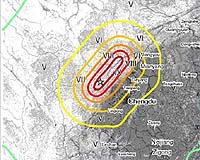
The 8.0-magnitude earthquake has increased risks along China's Dragon Gate seismic fault, a well-known geological landmark, Yun Xiaosu, vice head of the Ministry of Land and Resources, told reporters.
"As rain increases during the rainy season and coupled with the continuous aftershocks, it is very probable that geologic hazards in the disaster area will increase and again bring a large amount of losses," he said.
Heavy rains were likely to bring greater instability to the mountains that had already been greatly shaken by the earthquake and its nearly 170 aftershocks, Yun said.
"This has made the work of monitoring, prevention and mitigation of potential geologic disasters great and the tasks before us arduous," he said.
The quake, the biggest to hit China in more than 30 years, has left over 80,000 people dead or missing, and more than five million homeless.
Most of the flattened towns and villages have been along the 200-kilometre (120-mile) long Dragon Gate seismic fault in the Himalayan foothill region of Sichuan province.
Yun said one of the biggest concerns was the creation of 34 bodies of water known as "quake" or "barrier" lakes that formed after landslides blocked rivers. He said they could burst and threaten populated areas.
"We must be aware that the barrier lakes that we have identified are very serious," said Liu Yuan, vice director of the ministry's geologic environment department.
"I want to be clear about this in order to ensure safety — if these barrier lakes burst, the after effects will be severe over a wide area."
Officials had ordered people in all threatened areas near the quake lakes to evacuate, he said.
Experts were studying ways to engineer channels around or through the barriers to alleviate rising waters and reduce the potential dangers, especially on the Minjiang river, a major tributary of the Yangtze, he said.
The officials further warned that more quake lakes could be formed if the frequency of aftershocks, landslides and avalanches in the mountainous region increased during the rainy season, which begins next month.
On Thursday, the government announced that 167 aftershocks over 4.0 magnitude had struck along the Dragon Gate seismic fault since the May 12 quake, with four registering over magnitude 6.0.
The fault, also known as the Longmenshan fault, runs along the rugged and steep Dragon Gate mountains, which form a geological border between the plain of Sichuan province and the towering Himalayan mountains, the world's highest.
Yun said his ministry had identified more than 4,900 geological hazards along the Dragon Gate fault before the earthquake struck, of which 158 of them were considered major hazards.
