
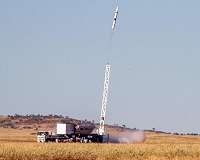
On Monday July 29, Gilmour Space Technologies attempted to launch our 'One Vision' suborbital rocket to flight test the company's proprietary orbital-class hybrid rocket engine and demonstrate our mobile launch capability.
At T-7 seconds to launch, the test rocket suffered an anomaly that resulted in the premature end of the mission. Initial investigations show that a pressure regulator in the oxidiser tank had failed to maintain the required pressure, and this caused the upper half of the rocket to be ejected as helium escaped.
On the positive side, there were no explosions due to the safe nature of hybrid rocket engines, and no observable damage to the engine.
Moreover, despite failure to launch, the team did successfully test Gilmour Space's mobile launch platform and mission control centre, which had journeyed over 1,800 km to the test site.
The automatic 'load-and-launch' ground support system performed nominally through countdown, and switched automatically into safe mode to dilute the oxidiser when the tank was compromised.
With this mobile launch system, we believe we have the capability to launch a light orbital vehicle from anywhere in Australia.
Importantly, our team is safe though understandably disappointed not to have completed the mission. As it was a third-party instrument that failed, we will be following up on the matter with them.
Whatever the case, rocket engineering is all about testing, failing, learning and rebuilding. One Vision was a development and test rocket, and our learnings from here have already informed many of the design features in our next vehicle.
Gilmour Space will now look to launch an enhanced version of this suborbital rocket in the near future, and test more of the technologies we will require for our orbital launches.
We appreciate your continued support as we work to build a safe and reliable road to space for the next generation of small satellites in LEO.
