
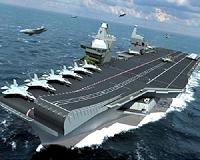
The two halves of Britain's second nuclear-powered aircraft carrier were joined this week at a shipyard in Scotland, the Royal Navy reports.
The so-called "skidding" process for HMS Prince of Wales took more over than 10 hours and involved the forward half of the ship, weighing about 29,211 tons, moved about 55.7 feet by a hydraulic system to marry with a 13,227-ton rear section known as the superblock.
"To see more than 26,000 tonnes (about 29,211 U.S. tons) of ship skidded in the dry-dock is an amazing sight and a very proud moment for the alliance," said Angus Holt, HMS Prince of Wales delivery director.
"The rate at which HMS Prince of Wales is coming together is also very gratifying; with the team doing a superb job in ensuring that we keep to our schedule. This will allow us to complete the assembly phase of the build by our target date of next year."
The Aircraft Carrier Alliance is a partnership between Britain's Ministry of Defense and BAE Systems, Thales UK, and Babcock for the construction of two Queen Elizabeth-class aircraft carriers.
The first QEC carrier is being outfitted and is expected to be commissioned into service in 2017.
The Royal Navy said the next stage in the assembly of HMS Prince of Wales will be the welding of the two sections, followed by pipework and the installation of electric cables.
U.S. and Chile strengthen naval partnership in training
Washington (UPI) Oct 29, 2015 -The U.S. Navy's nuclear-powered aircraft carrier USS George Washington hosted several Chilean officers as part of naval exercise UNITAS 2015.
Carrier Strike Group Nine and embarked Carrier Air Wing Two also took part in hosting the officers, as they participated in several exercises designed to improve cooperative relations during tactical engagements. UNITAS is the Navy's longest running multinational annual training exercise. Sailors from both the U.S. and Chile said the program is helpful for building working relationships.
"There are so many people aboard, and it is impressive how smoothly it all works," a Chilean naval officer said. "We've compared their leadership to our own and realized that we have many similarities and that we face the same challenges they do."
Lt. Anne Domko, who was assigned to Carrier Strike Group Nine during the exercise, said both forces were able to learn from each other.
"It took some coordination to integrate them into the work we were doing for the exercises but they were a valuable asset," Domko said in a statement. "We learned a lot from each other about the way our countries do business. The more we continue to increase interoperability between countries the better."
Chile hosted the first of two phases of UNITAS. The second phase, which will take place in November, will be hosted by Brazil.
