
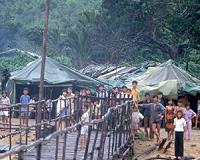
Nearly 600 boat people from Myanmar and Bangladesh stranded in northwest Indonesia were moved to a larger shelter Wednesday, where migrant groups expect they could spend months before having their claims processed.
The 582 migrants, including many ethnic Muslim Rohingya, had been housed in an overcrowded sports centre in Lhoksukon, a town in North Aceh, since they arrived by boat at the weekend.
But as facilities at the cramped centre reached breaking point, with few toilets and poor ventilation, local authorities began transferring migrants by bus Wednesday afternoon to a larger complex at Kuala Cangkoi, a fishing town on the north coast.
The site, comprising three large buildings and equipped with a small mosque, had been inspected by Indonesian officials and staff from the International Organization for Migration.
"It was something that was built after the tsunami and it ended up not being used after," the International Organization for Migration's Steve Hamilton told AFP, referring to the devastating natural disaster that devastated Aceh province in 2004.
Officials have begun the long process of verifying the identities of the migrants, with queues stretching back as photos are taken and personal details recorded.
The nearly 600 who arrived in Aceh were just a fraction of the 2,000 boat people from Myanmar and Bangladesh, including many Rohingya, who were rescued or swum to shore in Malaysia and Indonesia since the weekend.
The spate of arrivals comes as Thailand, a key stop on a Southeast Asian people-smuggling route, cracks down following the discovery of mass graves that has laid bare the extent of the thriving trade.
Boatloads have arrived off Aceh in the past, typically after becoming lost or running out of fuel.
Hamilton said with detention centres full across Indonesia, it was likely this latest wave of migrants would have to wait for their claims to be processed in Aceh.
"These people could be there six, seven, eight, nine months before they get transferred somewhere else," he said.
"There's nowhere to transfer them."
Thousands of impoverished Muslim Rohingya — a minority unwanted by Myanmar's government — and Bangladeshis brave a perilous sea and land trafficking route through Thailand and into Malaysia, Indonesia and beyond every year.
