
While aerial drones continue to increase in size and power for commercial use, toy drones aren't far behind. The pint-sized playthings are increasingly delivering some cool features for the casual user-and may point to where new and more serious applications lie ahead. Micro drones are all the rage in China, where their concealable size, durability, and relatively low cost make them ultra-convenient, and where factories can churn them out in large numbers.
Salespeople at Shantou-based KD-Model had their hands full with interested buyers at the recent Hong Kong Electronics Fair (Spring Edition) held in mid-April. Not yet two years old, KD, a unit of Wintide Brand Ltd. has rapidly begun exporting to Europe, Japan, Korea and the United States. Its overseas affiliates include Walmart, Disney, Carrefour, and Toys "R" Us.
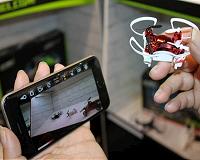
One of the firm's hottest selling miniature units is the palm-sized KD101 Nano Drone. Billed as one of the world's smallest mass-production drones, the plastic 13 gram toy measures 7.5cm x 7.5cm x 2.9cm, easily fitting in the palm of an adult hand.
KD sales manager Justin Chan manipulates a joy stick that immediately sends the drone aloft, its four tiny rotors whining as it gently glides around the company's booth at the fair. Its lithium-ion polymer (LiPo) battery can hold out for six to seven minutes of normal flight at a maximum range of about 20-30 meters.
"Young people love little drones for their cool design and amazing functions," says Mr. Chan, as he navigates the toy's control console, explaining some of its standard features, which include anti-avoidance and air pressure sensors. The unit also comes equipped with a one-button automatic return function. Like all of the company's items, the KD101 flies on the 2.4GHz frequency band, a common toy bandwidth.
For a lineup of mere toys, the Nano Drone and the rest of KD's micro drones sport other impressive attributes for their size, including an auto hover mode, two modes of joystick play, and easy USB battery charging. A Wi-Fi capable 720P HD camera can be linked to one's cell phone by downloadable app to allow for real-time display of recorded still and video images. Most of these goodies can be had for well under $35 per unit wholesale.
The convenient functions are intriguing enough to stir the imagination for how such toys might be 'repurposed' for more than just play, such as snooping and surveillance-jobs typically allocated to bigger, more sophisticated drones with longer battery lives and transmission ranges.
"Keep them small, quiet, and airborne, and it's easy to see how toys like these can be used for mischief," says Mr. Chan with a chuckle. "Although the drone industry in China is still new, we're pretty sure that the potential is limitless."
At the high end of its product line, the company offers larger drone kits such as the 115 gram four-rotor KD80 Modular Alien 3, which includes a remotely controllable on-board camera eye, modular battery, and a cell phone docking station on its control console.
"They're just toys now, but who knows about tomorrow?" muses Mr. Chan. "The late (Apple Computer founder) Steve Jobs was quoted as saying, 'People don't know what they want until you show it to them.' Just a few years ago, when the four-axis drone was still at the toy level, few people had ideas for how to use it."
Within the next decade, the aircraft industry will be expanded and all manner of uses for drones will be implemented on a step-by-step basis, he adds. "I'm sure that unmanned aerial vehicles (UAVs) will become an integral part of our lives."
