
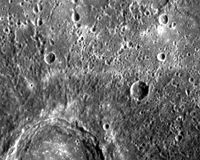
A day after its successful flyby of Mercury, the Messenger spacecraft turned toward Earth on Tuesday and began downloading the 500 megabytes of data that had been stored on the solid-state recorder during the encounter.
All of those data, including 1,213 images from the Mercury Dual Imaging System (MDIS) cameras, have now been received by the Science Operations Center at the Johns Hopkins University Applied Physics Laboratory in Laurel, Md.
Preliminary analysis of these data by the Messenger Science Team has confirmed that all seven Messenger instruments are healthy and operated as planned during the flyby.
As Messenger flew by the planet, it missed its targeted aim point by only 8.25 kilometers (5.12 miles), affording the critical gravity assist needed to continue on a course to become – in 2011 – the first spacecraft ever to orbit Mercury.
During this first encounter, the payload successfully conducted a carefully orchestrated sequence of observations designed to take full advantage of the geometry of the flyby trajectory and to optimize the science return from each instrument.
In addition to images of the previously unseen portion of the planet's surface, measurements were made that will contribute to the characterization of all aspects of Mercury and its environment, from its metallic core to the far reaches of its magnetosphere.
"We have one excited Science Team," says Messenger Project Manager, Peter D. Bedini, of APL, "and their enthusiasm is contagious."
The analysis of these data is just beginning, but there are already indications that new discoveries are at hand.
