
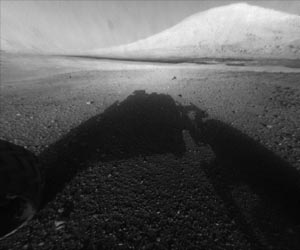
This image taken by NASA's Curiosity shows what lies ahead for the rover – its main science target, Mount Sharp. The rover's shadow can be seen in the foreground, and the dark bands beyond are dunes. Rising up in the distance is the highest peak Mount Sharp at a height of about 3.4 miles, taller than Mt. Whitney in California. The Curiosity team hopes to drive the rover to the mountain to investigate its lower layers, which scientists think hold clues to past environmental change.
This image was captured by the rover's front left Hazard-Avoidance camera at full resolution shortly after it landed. It has been linearized to remove the distorted appearance that results from its fisheye lens. Image credit: NASA/JPL-Caltech
Curiosity's First Color Image of the Martian Landscape
This view of the landscape to the north of NASA's Mars rover Curiosity was acquired by the Mars Hand Lens Imager (MAHLI) on the afternoon of the first day after landing. (The team calls this day Sol 1, which is the first Martian day of operations; Sol 1 began on Aug. 6, 2012.)
In the distance, the image shows the north wall and rim of Gale Crater. The image is murky because the MAHLI's removable dust cover is apparently coated with dust blown onto the camera during the rover's terminal descent. Images taken without the dust cover in place are expected during checkout of the robotic arm in coming weeks.
The MAHLI is located on the turret at the end of Curiosity's robotic arm. At the time the MAHLI Sol 1 image was acquired, the robotic arm was in its stowed position. It has been stowed since the rover was packaged for its Nov. 26, 2011, launch.
The MAHLI has a transparent dust cover. This image was acquired with the dust cover closed. The cover will not be opened until more than a week after the landing.
When the robotic arm, turret, and MAHLI are stowed, the MAHLI is in a position that is rotated 30 degrees relative to the rover deck. The MAHLI image shown here has been rotated to correct for that tilt, so that the sky is "up" and the ground is "down".
When the robotic arm, turret, and MAHLI are stowed, the MAHLI is looking out from the front left side of the rover. This is much like the view from the driver's side of cars sold in the USA.
The main purpose of Curiosity's MAHLI camera is to acquire close-up, high-resolution views of rocks and soil at the rover's Gale Crater field site. The camera is capable of focusing on any target at distances of about 0.8 inch (2.1 centimeters) to infinity. This means it can, as shown here, also obtain pictures of the Martian landscape.
Image credit: NASA/JPL-Caltech/Malin Space Science Systems
Curiosity's Early Views of Mars
This image shows one of the first views from NASA's Curiosity rover, which landed on Mars the evening of Aug. 5 PDT (early morning hours Aug. 6 EDT). It was taken through a "fisheye" wide-angle lens on one of the rover's Hazard-Avoidance cameras. These engineering cameras are located at the rover's base.
As planned, the early images are lower resolution. Larger color images are expected later in the week when the rover's mast, carrying high-resolution cameras, is deployed. Image credit: NASA/JPL-Caltech
Curiosity's Heat Shield in View
This color thumbnail image was obtained by NASA's Curiosity rover during its descent to the surface of Mars on Aug. 5 PDT (Aug. 6 EDT). The image was obtained by the Mars Descent Imager instrument known as MARDI and shows the 15-foot (4.5-meter) diameter heat shield when it was about 50 feet (16 meters) from the spacecraft.
It was obtained two and one-half minutes before touching down on the surface of Mars and about three seconds after heat shield separation.
It is among the first color images Curiosity sent back from Mars. The resolution of all of the MARDI frames is reduced by a factor of eight in order for them to be promptly received on Earth during this early phase of the mission.
Full resolution (1,600 by 1,200 pixel) images will be returned to Earth over the next several months as Curiosity begins its scientific exploration of Mars.
The original image from MARDI has been geometrically corrected to look flat.
Curiosity landed inside of a crater known as Gale Crater. Image credit: NASA/JPL-Caltech/MSSS
