
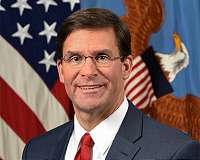
U.S. Defense Secretary Mark Esper has enacted a 60-day stop movement order for all uniformed service members and their families as well as civilian service members stationed overseas, the Pentagon confirmed Wednesday.
The measure is intended to stop the spread of the novel coronavirus and to "protect U.S. personnel and preserve the operational readiness of our global force," said a Pentagon statement sent to UPI.
"Building upon previously enacted movement restrictions governing foreign travel, permanent change of station moves, temporary duty and personal leave, this stop movement order will also impact exercises, deployments, redeployments and other global force management activities," the statement said.
The order impacts an estimated 90,000 service members who are either slated to deploy or redeploy over the next 60 days.
The order includes some conditions under which exceptions can be granted.
They include: travel by patients and medical providers for treatment; scheduled deployments or redeployments of U.S. Navy vessels and embarked units; individuals who have already initiated travel.
Troops whose temporary duty assignment ends while the order is in effect are authorized to return to their home station, according to the Pentagon.
Other exceptions may be granted on a case by case basis, including situations where travel "is deemed mission essential, humanitarian in nature or warranted due to extreme hardship."
The statement also said the order "is not expected to impact the continued drawdown of U.S. forces from Afghanistan, which is scheduled to be complete within 135 days following the signed agreement."
Troop rotations into and out of Afghanistan had already been paused amid the pandemic.
Last week NATO Resolute Support announced it would pause troop rotations into and out of Afghanistan in order to halt the spread of the novel coronavirus, placing individuals leaving and individuals returning in screening facilities for 14 days.
Earlier in March, the Pentagon restricted domestic travel for military members and their families due to the coronavirus.
Pentagon officials said Wednesday they believe the pandemic will continue to grow for the next three weeks, but that the department has not able to model further than that.
"It's a worrisome narrative when we try to say there's some reason that we should question the guidance that's being given out, or there's some reason why we should pull apart a shared approach to this," said Joint Staff Surgeon Brig. Gen. Paul Friedrichs at a press briefing at the Pentagon. "I don't think it matters what day things start to get better. What matters is what we're doing right now to mitigate this outbreak."
Navy postpones Large Scale Exercise 2020 in response to COVID-19
Washington DC (UPI) Mar 25, 2020 –
The Navy confirmed Wednesday that it has postponed its Large Scale Exercise 2020 as the Navy and the joint force respond to the COVID-19 pandemic.
Inside Defense first reported that the exercise will be postponed until 2021 to keep the fleet healthy but also to allow the services to contribute to whole-of-government efforts around the country.
The exercise was on track to continue as late as last week.
According to the Pentagon, the cancellation was a joint decision made by U.S. Fleet Forces, U.S. Pacific Fleet and U.S. Naval Forces Europe.
According to USNI News, this was to be the first fleet exercise that incorporated unmanned technologies, as well as information warfare.
"We don't do anything in the U.S military today without leveraging space," CNO Admiral Mike Gilday said in December. "It's the same thing with cyber. It's why I want small tactical fleet cyber teams," he said, adding that LSE 2020 would include a pilot program establishing information warfare cells and tactical cyber teams that work inside the existing fleet maritime operations center.
LSE 2020 is one of several exercises affected as the military adapts to social distancing recommendations and also offers its resources to help the U.S. health care system respond to the spread of the virus.
U.S. European Command and the Army have also altered plans for the Defender 2020 exercise scheduled later this spring, which was to bring 37,000 personnel from 18 countries from various parts of Europe.
