
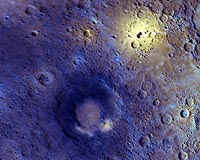
MESSENGER mission controllers at the Johns Hopkins University Applied Physics Laboratory (APL) in Laurel, Md., successfully conducted a maneuver today designed to raise the spacecraft's minimum altitude sufficiently to extend orbital operations and delay the probe's inevitable impact onto Mercury's surface until early next spring.
The immediately previous maneuver, completed on October 24, 2014, raised MESSENGER to an altitude at closest approach from 25.4 kilometers (15.8 miles) to 184.4 kilometers (114.6 miles) above the planet's surface. Because of progressive changes to the orbit over time, the spacecraft's minimum altitude continued to decrease.
At the time of this most recent maneuver, MESSENGER was in an orbit with a closest approach of 25.7 kilometers (16.0 miles) above the surface of Mercury. With a velocity change of 9.67 meters per second (21.62 miles per hour), the spacecraft's four largest monopropellant thrusters (with a small contribution from four of the 12 smallest monopropellant thrusters) nudged the spacecraft to an orbit with a closest approach altitude of 105.1 km (65.3 miles).
This maneuver also increased the spacecraft's speed relative to Mercury at the maximum distance from Mercury, adding about 3.7 minutes to the spacecraft's eight-hour, 12.9-minute orbit period. This maneuver was the first during the mission to intentionally use both fuel and gaseous helium pressurant to impart the desired velocity change. The propellant was drawn from a small auxiliary fuel tank, and the gaseous helium was drawn from the main fuel tanks.
"This maneuver has demonstrated the safety of this concept and will allow us to characterize system performance during the use of cold gas propellant," said MESSENGER Mission Systems Engineer Dan O'Shaughnessy, of APL. "Such characterization will be necessary to forecast accurately the timing of the spacecraft's surface impact and to plan low-altitude maneuvers for the remainder of the mission."
This view shows MESSENGER's orientation soon after the start of the maneuver. The spacecraft was 118.9 million kilometers (73.9 million miles) from Earth when the 1-minute, 49-second maneuver began at 1:27 p.m. EDT. Mission controllers at APL verified the start of the maneuver 6.6 minutes later, after the first signals indicating spacecraft thruster activity reached NASA's Deep Space Network tracking station in Goldstone, California.
The next maneuver, on March 18, will again raise the spacecraft's minimum altitude, allowing scientists to continue to collect images and data from MESSENGER's instruments.
