
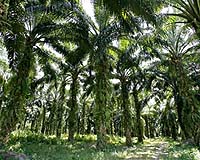
A minister on Thursday defended Malaysia's plantation industry and said tropical rainforests have not been cleared to plant palm oil in the last 10 years. Plantations Minister Peter Chin was refuting allegations that palm oil production destroys rainforests and wildlife habitats or that it increases greenhouse gas emissions and leads to a loss in biodiversity. "I would like to reiterate here that Malaysia is not destroying rainforests for palm oil production," he said.
"We have not cleared rainforest for palm oil plantation for the past 10 years," Chin told an international conference on biofuels.
The minister said palm oil production is sustainable and meets European Union criteria as a biofuel source.
Malaysian planters are focusing on increasing productivity by replanting with higher yielding clones and adopting good agronomic practices, Chin said.
"We are committed to ensuring that whatever we do now is not at the expense of the environment and our future generations," he said.
Chin led a delegation to Europe last month as part of a campaign to dispel concerns that palm oil plantations endanger tropical forests.
Sabri Ahmad, chairman of the Malaysian Palm Oil Board, said 65 percent of Malaysia's total land area of almost 33 million hectares comprises of forest.
He said agriculture occupies only 19 percent of the land mass and that palm oil plantations use 12 percent.
"In contrast, agricultural land accounts for 70 percent of total land area in developed countries while forest cover comprises between 10 and 30 percent," Sabri told the conference.
Sabri also said crude palm oil (CPO) prices are expected to remain above 2,000 ringgit (580 dollars) per tonne over the next 12 months, led by strong demand from China and India.
"Today, the price is still hovering about 2,500 ringgit to 2,600," he said, adding that the high price was due to a 5 to 10 percent fall in production in Malaysia and Indonesia, the world's top two CPO producers.
Demand for biofuels is set to boom in Europe in the coming years after European Union leaders agreed in March that bio-fuels, made from plants, should make up 10 percent of total vehicle fuel in the 27-nation bloc by 2020.
Malaysia last year launched a national biofuel policy to encourage production from palm oil for export, and the use of palm biofuel blended with petroleum diesel domestically.
earlier related report
Malaysian PM vows to crack down on illegal logging
Kuala Lumpur (AFP) – Malaysian Prime Minister Abdullah Ahmad Badawi on Tuesday vowed to fight illegal loggers amid claims from local and opposition leaders that criminal syndicates are engaged in the activity.
"We will make sure our enforcement is tough (to protect the environment)," he told reporters at the sidelines of an international commodities conference.
Last month Abdul Taib Mahmud, chief minister of timber-rich Sarawak state on Borneo island revealed that gangsters were hired by illegal loggers to guard their logging operations, especially in protected areas.
"They not only encroach the forests, but also fell trees in the national parks," he was quoted as saying by Bernama news agency.
Chong Chieng Jen, opposition lawmaker with the Democratic Action Party lawmaker for Bandar Kuching in Sarawak told AFP that criminal gangs have been engaged in illegal logging for the past few years.
"It is shocking that only now, the chief minister is admitting it. Gangsters have been involved in illegal logging activities for at least five years," he said Tuesday.
The industry-backed Malaysian Timber Council reported a decline in illegal logging to 123 cases last year from 138 in 2005.
Earlier, Abdullah said that since land was becoming scarce in Malaysia, plantation owners cannot depend on opening up new land schemes due to environment concerns.
"It is important that you increase your productivity," he said.
Malaysia is the world's largest producer of palm oil. It is battling environmentalists' claims that plantations destroy vast swathes of tropical forest, pushing endangered animals like the orangutan towards extinction.
Source: Agence France-Presse
