
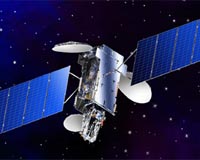
After weeks of wrangling with its insurance agents and potential third party purchasers, the world's leading GEO satellite fleet operator SES Global has on sold its failed AMC-14 GEO satellite to the United States Air Force for an undisclosed amount.
Sources tell SpaceDaily that orbital maneuvers to begin moving the satellite to it's new partial-GEO orbit at an inclination of 15 degrees will begin soon.
However, sources continue to say that the US Air Force appears to remain unaware that they can fly the spacecraft around the Moon and get 6 years of life at GEO. "They are going to take eight months to get it to a 15 deg orbit with no fuel, rather than take 8 months to get to GEO with a 0 inclination mission and 6 years of fuel."
Attempts by third parties to buy the satellite from the underwriters have come to naught. The insurers are reported to have preferred the easy route of paying out SES and letting the high margin insurance premiums still being charged in the GEO satellite market pay for the cost of throwing away a fully functional broadcasting satellite.
Sources continue to maintain that the satellite is salvageable and that the lunar flyby technique used previously for Asiasat-3 could be used to bring the satellite into a stable GEO orbit where it could operate for many years.
The issue now turns to legality of the US Air Force owning a satellite for services that could be provided by the private sector, and which according to some is required under the commercial space act.
Whether any of the third parties that had tried to buy the satellite are prepared to take on the US Air Force remains to be seen.
earlier related report
SES Negotiating To Sell AMC-14 To US Government Agency
The fate of geo stationary satellite AMC-14 that failed to achieve its desired orbit in March continues to cause problems for the Luxembourg-based SES group and its underwriters.
SpaceDaily has learned that SES has backtracked on their original plan to ditch the Lockheed Martin built A2100 satellite, and is trying to offload the spacecraft to a US government agency before an SES competitor or even one of its own customers buys it from the underwriters.
Sources have told SpaceDaily that a US Department of Defense agency is negotiating to buy the AMC-14 satellite from SES directly with a loss adjustment then to be paid out by the underwriters. The US government would then move AMC-14 to a geostationary orbit inclined at roughly 10 degrees to the equator.
Sources warned "the government is being had. SES is selling them an inferior mission. SES is purposefully downplaying the other options to protect themselves."
As reported earlier in SpaceDaily SES is reluctant to pursue a rescue that uses a Lunar flyby due to a legal dispute with Boeing involving several issues including a patent that lays claim to the lunar flyby process.
At the same time, there are other issues with such a purchase.
A government purchase and use of this spacecraft may be a violation of the Commercial Space Act of 1998, which prohibits US government agencies from owning spacecraft to produce products they can buy commercially.
"Any capability available on AMC-14 can be purchased commercially. If the government needs this sort of service, they must buy it from commercial providers as the 1998 Commercial Space Act requires." an industry expert requesting anonymity told SpaceDaily.
Meanwhile, the lunar flyby rescue option continues to be dismissed by SES to their potential government customer and to the underwriters.
"The last thing they want is for that option to be proven out. They told the underwriters that only an inclined orbital profile was available. It would look bad if someone were to salvage the spacecraft and perform the lunar transfer mission."
While the underwriters may have been misled, they are more worried about offending SES than they are about paying out. SES is the biggest player in the GEO market and an endless source of rich insurance premiums.
Further complicating the situation is the entry of several other commercial entities that are negotiating with the underwriters to buy the satellite and then use the lunar flyby process to recover the satellite into GEO.
Despite claims by SES that "the numbers didn't work" for even a two to three year mission lifetime, experts have mapped out a mission profile similar to the 1998 HGS-1 trajectory that produces more than five years of operational lifetime in a GEO orbit.
Of critical concern for SES at this stage is preventing negotiations between the underwriters and these other entities from coming to fruition. SES would like to both get the payoff from the underwriters and to prevent the spacecraft from ending up in the hands of competitors.
"They would specifically like to prevent the vehicle from being bought by Echostar, the customer that originally intended to lease AMC-14 from SES," sources told SpaceDaily.
Echostar announced in March the creation of a separate business unit that would compete with SES for fixed satellite services.
earlier related report
Boeing Patent Shuts Down AMC-14 Lunar Flyby Salvage Attempt
Attempts to salvage a wayward GEO comsat have come unstuck in the face of institutional disinterest and an aging patent of questionable validity.
The AMC-14 commercial geostationary satellite was launched in March by a Proton launch vehicle into space just short of its minimum geostationary transfer orbit (GTO).
SES Americom, the world's largest commercial satellite firm, owns the satellite and was to lease capacity on AMC-14 to the Echostar group.
Following the failed launch, SES Americom looked into how they might salvage the satellite in a manner similar to the Asiasat-3 salvage in 1998.
However, SpaceDaily has now learned that a plan to salvage AMC-14 was abandoned a week ago when SES gave up in the face of patent issues relating to the lunar flyby process used to bring wayward GEO birds back to GEO Earth orbit.
Sources have told SpaceDaily that it was possible to bring AMC-14 back via the moon to a stable GEO orbit where the high powered satellite would have been able to operate for at four years and probably longer.
In the face of unrelated legal battles between the current patent owner Boeing and the satellite's owner SES Americom – any efforts to salvage AMC-14 have been cast aside.
Primarily this is because SES is currently suing Boeing for an unrelated New Skies matter in the order of $50 million dollars – and Boeing told SES that the patent was only available if SES Americom dropped the lawsuit.
Industry sources have told SpaceDaily that the patent is regarded as legal "trite", as basic physics has been rebranded as a "process", and that the patent wouldn't stand up to any significant level of court scrutiny and was only registered at the time as "the patent office was incompetent when it came to space matters".
SES has decided not to pursue any legal options against Boeing and wants to collect their insurance policy payout. However, their insurance company was not being fully briefed on the options and at this time is planning to pay the policy out.
Separately, another company has approached the insurers about buying the spacecraft for salvage using the lunar flyby option. Initially, the insurers were surprised as they had no knowledge of this option and suggested that they contact SES Americom directly.
While most satellite insurance policies allow the insurer to take ownership of a satellite when they pay a claim, they rarely do this. The default is instead to leave "ownership" with the operators, who are then legally obliged to safely deorbit the satellite or move the satellite into a GEO parking orbit.
At this stage SES Americom is working with a major US space consultancy to rapidly deorbit the satellite – as early as this Friday. SpaceDaily has been told that various attempts by third parties to buy the satellite have been ignored and both parties are "eager to splash the satellite within days".
earlier related report
SES AMERICOM Declares To Insures AMC-14 Satellite A Total Loss
SES S.A. announced Friday that its North American subsidiary, SES AMERICOM, has declared to insurers that its recently launched satellite – AMC-14 – is now considered a total loss, due to a lack of viable options to reposition the satellite to its proper geostationary orbit.
"SES and Lockheed Martin have carefully examined all the available options for repositioning this satellite into its intended geostationary orbit," said Edward Horowitz, President and CEO of SES AMERICOM.
"Unfortunately, none of those options would allow effective use of the spacecraft. The various repositioning scenarios presented carry unacceptable risks, and would result in a severely shortened life of the satellite. Therefore, we have no choice but to claim a total loss of the satellite with our insurers."
AMC-14 was built by Lockheed Martin Commercial Space Systems, and launched on a Proton/Breeze M rocket provided by ILS (International Launch Services) from the Baikonur Cosmodrome in Kazakhstan.
The launch of AMC-14 failed on March 15 when an anomaly during the second burn of the fourth stage of the rocket resulted in the satellite being placed short of the planned geostationary transfer orbit.
While an initial assessment of the available options to reposition the satellite appeared encouraging, more detailed examinations by SES and Lockheed Martin engineers determined that the various scenarios could not provide a reasonable chance of success.
Mark Rigolle, Chief Financial Officer of SES commented: "The loss of any satellite is a disappointment, and the failure of AMC-14 means there will be no revenues to come from this programme. However, SES is fully insured for its investment, and there will be no negative P and L impact from the accelerated writedown of AMC-14.
"We expect to receive the insurance proceeds of approximately USD 150 million in the next few months, thereby enhancing our cash position. The rest of our business in North America and worldwide has no connection with, and is unaffected by, this launch failure."
While AMC-14 is currently in a stable orbit, SES is exploring plans to retire the satellite.
