
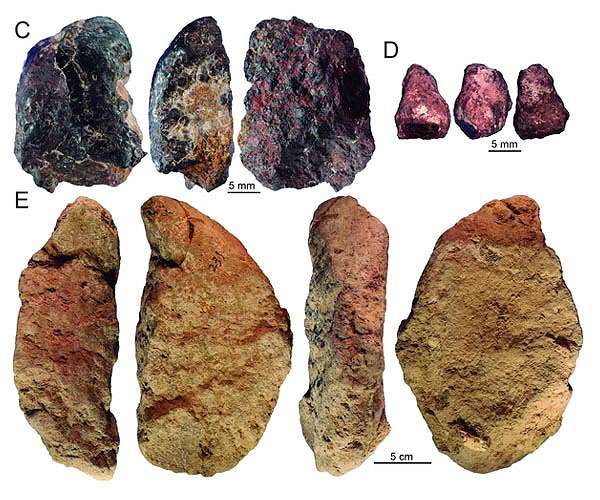
An international team of researchers has identified the world's oldest ochre mine, located in the Lion Cavern in Eswatini, southern Africa. Using luminescence dating and geochemical analysis, the study determined that mining activities at this site began approximately 48,000 years ago. This research also revealed how ochre was distributed to surrounding areas. The team examined 173 samples from 15 Stone Age sites to understand extraction methods, usage, and the transport networks related to ochre.
Ochre, an iron-rich natural pigment, has been significant for millennia, often used in cave art and for decorating symbolic items and personal adornments. It holds cultural, spiritual, and historical value, providing insight into early human societies and their expressions.
The research team developed a geochemical fingerprint for ochre found in the Lion Cavern area by making small ochre samples temporarily radioactive through neutron irradiation. The decay of these samples produced measurable energy emissions, revealing their origin and formation. Advanced laser techniques were also applied to identify the molecular composition of the ochre.
Dr. Svenja Riedesel from the Cologne Luminescence Laboratory at the University of Cologne's Institute of Geography participated in dating the samples. Riedesel explained that luminescence dating relies on how quartz or feldspar grains capture energy from their environment. This energy accumulates over time due to natural ground radiation and is stored in the material's crystal defects. "To determine the age of a material, we take a sample and expose it to light or heat in the laboratory," Riedesel stated. This process releases stored energy as a faint light, known as luminescence, which helps estimate how long the material has been shielded from light or heat.
Quartz grains were used to date the material from the abandoned Lion Cavern mine, showing evidence of mining activity dating back at least 42,000 years. This supports prior findings of ochre extraction at the site around 48,000 years ago. "With the help of Optically Stimulated Luminescence dating, we were able to prove that this is the oldest known ochre mine in the world," Riedesel concluded.
Research Report:Ochre communities of practice in Stone Age Eswatini
