
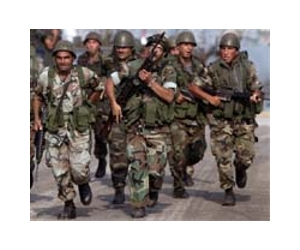
The Lebanese army, which said on Monday it was determined to restore order in a country which has been roiled by growing political tensions linked to neighbouring Syria, is traditionally seen as a peacekeeping force rather than an army.
Tensions have risen in Lebanon since Friday's murder in a car bombing of police intelligence chief Wissam al-Hassan, an anti-Syrian Sunni Muslim.
According to the "The Military Balance," an annual report published by the International Institute for Strategic Studies (IISS) in London, the Lebanese army numbers about 57,000 troops.
The interior security force of 20,000 personnel comes under the authority of the interior ministry.
There are more are police officers than soldiers. At most 25,000 have experience from the 1975-1990 civil war and the army is considered more of a peacekeeping force than an offensive one.
Badly equipped, the army has at its disposal some 326 tanks, mainly Soviet-built T-54s and T-55s. It also has some 1,240 armoured personnel carriers and 522 artillery pieces.
There are 1,100 men in the Marines and 1,000 in the air force, according to the IISS.
In the 1980s, in the depths of the 1975-1990 civil war, the army was divided along multi-confessional lines just like the country, which led to its fragmentation.
Since the end of that conflict, the army has reformed to become an institution which is often put forward as the only stable pillar of the state.
In mid-2006, the army stayed in the background during the conflict between Hezbollah and Israeli forces, in which 1,200 people, mainly civilians, were killed in Lebanon and 160, mostly soldiers, in Israel.
The conflict in Syria, which has been rocked since March 2011 by deadly violence, has also affected Lebanon which went through 30 years of Syrian domination and remains deeply divided between supporters and opponents of the Damascus regime of President Bashar Al-Assad.
Since the beginning of the Syria conflict, shells have often been fired from across the border. Gunfire is also frequently recorded at the frontier, and the Lebanese army has reinforced its presence along the border several times.
