
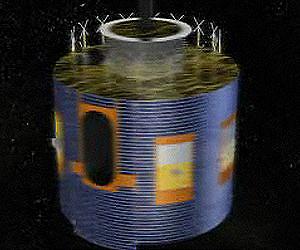
Arianespace has announced that the launch date of the MSG-3 satellite from the European Spaceport in Kourou, originally foreseen for 19 June, has been reset to the evening of the 5 July 2012. The delay is due to additional checks that were made on the EchoStar 17 telecommunication satellite, which is to be launched together with MSG-3 on the Ariane 5 ECA launcher.
MSG-3 has successfully passed a series of tests scheduled by ESA and industry and is ready to be fuelled.
The launch of MSG-3 will secure continuity of observations from geostationary orbit 36,000 km from Earth. This service, currently provided by Meteosat-9 and the ageing Meteosat-8, launched in August 2002, is vital to ensure the safety of lives, property and infrastructure, particularly in situations of severe weather.
The launch of MSG-3 is timed for the smooth transition from Meteosat-8, which has greatly exceeded its expected lifetime.
The MSG satellite series is the result of the successful cooperation model with the European Space Agency (ESA), which develops the satellites according to EUMETSAT's requirements and procures recurrent units on the latter's behalf from the European space industry.
All MSG satellites are manufactured by a European consortium led by Thales Alenia Space.
The European Organisation for the Exploitation of Meteorological Satellites is an intergovernmental organisation based in Darmstadt, Germany, currently with 26 European Member States (Austria, Belgium, Croatia, Czech Republic, Denmark, Finland, France, Germany, Greece, Hungary, Ireland, Italy, Latvia, Luxembourg, the Netherlands, Norway, Poland, Portugal, Romania, Slovakia, Slovenia, Spain, Sweden, Switzerland, Turkey and the United Kingdom) and five Cooperating States (Bulgaria, Estonia, Iceland, Lithuania, and Serbia).
EUMETSAT operates the geostationary satellites Meteosat-8 and -9 over Europe and Africa, and Meteosat-7 over the Indian Ocean.
Metop-A, the first European polar-orbiting meteorological satellite, was launched in October 2006 and has been delivering operational data since 15 May 2007.
The Jason-2 ocean altimetry satellite, launched on 20 June 2008, added ocean surface topography to the missions EUMETSAT conducts.
The data and products from EUMETSAT's satellites make a significant contribution to weather forecasting and to the monitoring of the global climate.
