
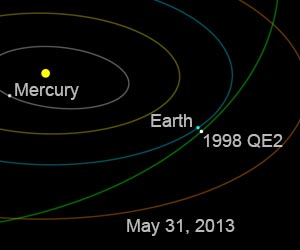
A 1.7-mile-wide asteroid whose moon alone had the potential to cripple life on Earth passed safely by under the close watch of scientists, NASA said.
The massive rock, known as 1998 QE2, came within 3.6 million miles of smashing into Earth before continuing into deep space, CNN reported.
The asteroid has its own satellite that is about 2,000 feet across.
Astronomers never feared a strike from the pair, but were excited about the chance to get "the best look at this asteroid ever," NASA said.
The ability to track and photograph the asteroid was considered a success for the agency's Near Earth Object Project, which surveys the outreaches of space for objects with the potential for striking the Earth.
QE2's moon alone is considered a "potential city killer," said Paul Chodas, a scientist with the project. Scientists projected it would have caused a global catastrophe if it collided with the planet.
Astronomer Lance Benner, principal investigator for the Goldstone observatory in California, said high-resolution radar images of the asteroid produced by Goldstone and the Arecibo observatory in Puerto Rico "could reveal a wealth of surface features," NASA's Jet Propulsion Laboratory said in a statement.
The radar at Goldstone is capable of discerning features as small as 12 feet across.
Both observatories continue to track QE2 as it moves away from the Earth.
The asteroid is expected to pass Earth again on July 12, 2028, but at a distance of about 45 million miles.
