
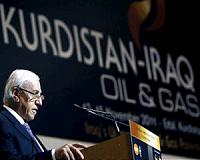
The market for crude oil produced in the Kurdish north of Iraq is evolving rapidly both in the domestic and foreign markets, an oil company executive said.
Iraqi and Kurdish leaders this week brokered a deal breaking a simmering impasse over oil in the country. Both sides have been at odds over jurisdictional issues.
Michael Ebsary, chief executive officer at Oryx Petroleum, said the progress made in settling longstanding issues in the Iraqi oil sector was very encouraging.
"Such progress has many positive implications for sales of crude oil produced in the Kurdistan region to both export and domestic markets as well as for the fiscal stability and security of the Kurdistan region," he said in a Thursday statement.
The semiautonomous Kurdistan Regional Government under the terms of the agreement funnels 250,000 barrels of oil per day to Baghdad and agrees to use the federal State Oil Marketing Organization for marketing. Both sides will also facilitate exports from oil fields in disputed territory in Kirkuk.
Oryx said it was working with the Kurdish government to organize deliveries of oil taken from the region's Demir Dagh oil field by truck to a crossing point for a Turkish pipeline. The company said it was working to tie into that pipeline directly by 2015.
Gross production for Demir Dagh for the end of the year is estimated at about 15,000 bpd. The company said some of the production at the field has been idled for most of the latter part of the year, however.
"Drilling and facilities construction at the Demir Dagh field continues and we remain on track to have the productive capacity to meet expectations for 2014 and 2015," Ebsary said.
The Kurdish government receives 17 percent of all oil revenue from the federal government. A portion of the revenue goes to finance operations of the Iraqi military and the Kurdish force known as Peshmerga.
Kurdish Prime Minister Nechirvan Barzani said the allocation for Peshmerga is separate from the 17 percent revenue quota.
"This agreement is very important because, after 11 years of negotiations, Baghdad agreed to the proposal to allocate a portion of the national defense budget to the Peshmerga forces," he said.
Peshmerga helped secured parts of northern Iraq under threat from the group calling itself the Islamic State.
Oryx, which has headquarters in Canada, said most of its operations in the Kurdish north of Iraq were secured from violence.
