
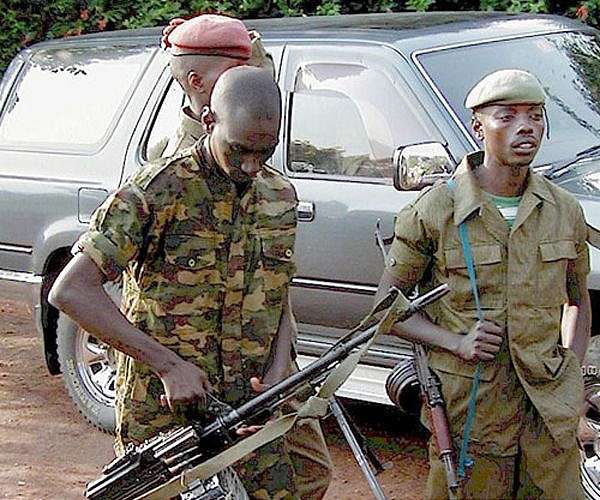
Nairobi will host talks between rebels operating in the Democratic Republic of Congo's violence-torn east and the Kinshasa government, the Kenyan presidency said on Thursday.
The mineral-rich DRC is struggling to contain dozens of armed groups in the east of the nation, many of which are a legacy of two regional wars a quarter of a century ago.
Millions of people died from violence, disease or starvation in the 1996-7 and 1998-2003 Congo Wars — a conflict that enmeshed countries from around east and central Africa.
On Thursday, the leaders of Kenya, Uganda, Burundi, Rwanda and the DRC met in Nairobi to discuss the crisis, with Kenya's presidency later announcing that the Kinshasa government would hold a "consultative meeting" with the rebels on Friday.
Kenyan President Uhuru Kenyatta "graciously agreed to host and provide logistical support for the consultations in Nairobi", it said, without naming the rebel groups invited to the meeting.
The Nairobi talks come barely a month after the DRC was admitted to the regional East African Community (EAC), a seven-nation bloc with a single market allowing free trade and movement of citizens.
The Kenyan presidency said Thursday the leaders were looking at establishing a regional force to neutralise rebel groups operating in the region.
"The meeting directed that planning for such a force commence with immediate effect," it said.
All foreign armed groups in the DRC — a nation of some 90 million people — were aso urged to disarm immediately and return to their countries of origin.
Any groups who failed to cooperate with the directive "would be considered as negative forces and handled militarily by the region", it added.
The M23 group, which emerged out of an ethnic Tutsi Congolese rebellion that was once supported by Rwanda and Uganda, clashed with government troops in the Congo's east before announcing a retreat this month.
Meanwhile the Allied Democratic Forces (ADF) rebel group — which the so-called Islamic State describes as its local affiliate — has been blamed for thousands of deaths in eastern DRC as well as a spate of bomb attacks in the Ugandan capital Kampala.
Niger MPs to vote on foreign troop presence
Niamey (AFP) April 21, 2022 –
Niger's MPs will on Friday for the first time debate the presence of foreign forces fighting jihadists in the impoverished Sahel nation, government and parliamentary sources told AFP.
A vote will follow, a government source said, as an official document handed to lawmakers said that new facilities will be built for these forces.
Some activists are campaigning against the presence of foreign troops, branding them occupiers who threaten national sovereignty.
However, the outcome of the vote is in little doubt with the parliament in Niamey totally dominated by allies of President Mohamed Bazoum.
Niger has the support of several Western countries in its battle against Al-Qaeda and Islamic State-linked jihadists, including the United States and France, which have military bases in the capital and the Agadez region in the north.
According to the government document handed to MPs and seen by AFP, Niger "is virtually surrounded by terrorist groups.
"Despite the efforts to contain the threat along our borders, the human and economic cost is heavy."
The situation, it says, requires Niger and other countries to commit to "an effective fight against terrorism, in the framework of bilateral or multilateral cooperation, either current or in the future."
"The special forces of friendly countries will be deployed … (and) installed on the territories of members of ECOWAS (Economic Community of West African States) facing the threat."
These include Benin, Ghana, Niger and Ivory, the document adds.
US and French special forces are already operational in Niger, which has declared itself ready to host more. But their possible deployment in the other countries has not been officially mentioned previously.
The document says that in Niger, "which already houses foreign troops bases, new sites will be set up nearer the theatres of operation" in Mali, where multiple jihadist groups operate.
"The locations and operational methods" of these forces will be discussed with Niger's military hierarchy, it says.
France is reconfiguring its anti-jihadist forces in the Sahel after its relationship with Mali broke down following a military coup in August 2020.
Germany, which runs a logistics outpost in Niamey, has set up a centre close to the border with Mali to train Nigerien special forces. Italy and Canada are also involved in special forces training.
The poorest country in the world according to the benchmark of the UN's Human Development Index (HDI), Niger is facing two jihadist insurgencies.
One is unfurling in the southwest of the country, coming from neighbouring Mali, while the other is in the southeast, from Nigeria.
Criticism of the presence of foreign forces prompted Bazoum to announce in February that he would ask parliament to agree on any new "arrangements" with foreign partners to tackle the jihadists.
