
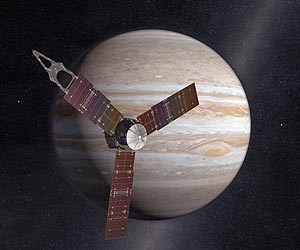
On Friday, Aug. 5, the launch window for NASA's Jupiter-bound Juno mission opens at 8:34 a.m. PDT (11:34 a.m. EDT) and extends through 9:43 a.m. PDT (12:43 p.m. EDT) at the Cape Canaveral Air Force Station in Florida. The satellite observatory is nestled inside the top of a United Launch Alliance Atlas V 551 rocket, the most powerful Atlas rocket in NASA's inventory.
The solar-powered Juno spacecraft will orbit Jupiter's poles 30 times to find out more about the gas giant's origins, structure, atmosphere and magnetosphere.
Timeline of expected launch milestones:
Launch
Right after launch, the rocket will be airborne, carrying Juno up and over the Atlantic Ocean.
+ Solid rocket motors jettisoned – occurs at about launch plus 106 seconds
The five solid rocket motors that have been providing some extra "get-up-and-go" for Juno's Atlas will complete their burn and be "stagger jettisoned." First, solids 1 and 2 separate from the rocket, followed 1.5 seconds later by solids 3, 4 and 5.
+ Fairing and stages separate – occurs at about launch plus 4 minutes, 45 seconds
The Atlas's 68-footlong (21-meter-long) nose cone, or fairing, will separate and be jettisoned as planned, providing Juno and its Centaur upper stage with their first taste of exo-atmospheric existence. The Atlas V's 106.6 foot-long (33-meter-long) first-stage will have completed its tour of duty. The Centaur upper stage, which will provide the final kick for Juno, will begin the first of two scheduled burns.
+ Parking at 17,500 miles per hour – occurs at about launch plus 10 minutes, 45 seconds
The Centaur upper stage will temporarily stop firing, as planned, and the rocket and Juno will begin a planned 30-minute coast phase, also known as a "parking orbit."
+ Centaur burns for Jupiter – occurs at about launch plus 41 minutes, 33 seconds
The Atlas V's Centaur upper stage will begin a second burn. This approximately nine-minute-long burn will place Juno on its desired trajectory.
+ Spacecraft separates from Centaur – occurs at about launch plus 56 minutes
The Juno spacecraft will separate from the Centaur upper stage of its Atlas V rocket. At this point, Jupiter will be five years and 1,740 million miles (2,800 million kilometers) away.
