
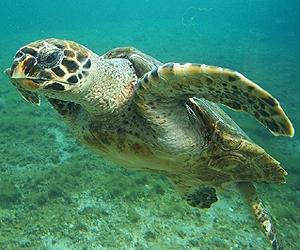
Thirteen endangered sea turtles bred in captivity in Japan have been given to a Singapore aquarium to prepare them for release into a natural habitat later this year, scientists said Friday.
The hawksbill turtles, listed as a highly endangered species, were brought to Singapore by their Japanese caretakers Tomomi Saito and Yoshihiko Kanou from the Port of Nagoya Public Aquarium.
The five one-year-old turtles and eight three-year-olds were turned over on Thursday to the Underwater World Singapore, which is collaborating with the Nagoya aquarium to release the animals.
They are the offspring of hawksbill turtles donated by the Underwater World Singapore to the Nagoya aquarium in 1997 and 2002.
As part of the preparations, staff from the Singapore aquarium will monitor and conduct checks on the turtles to determine their fitness for the release scheduled in September.
"With the success of their breeding… we would want to have some of these captive-bred turtles return to the wild," said Anthony Chang, curator of the Underwater World Singapore.
He said that releasing older turtles that are bred in captivity will improve their chances of survival.
"We know that on the beaches, when turtle eggs hatch, people will poach them," Chang told AFP.
"The turtles may be collected by people and they may be eaten up. The survivability of the small babies is very, very low."
Turtle soup is a delicacy in parts of Asia. Turtle shell is turned into powder and used as an ingredient for a jelly dessert.
Prior to their release, the turtles will be fitted with satellite devices attached to the back of their shells, allowing the scientists to learn about their migratory behaviour and survivability.
Their findings will be reported at an international convention on biological diversity in Nagoya in October.
Rare Saiga antelopes 'poisoned' in Kazakhstan: official
Astana (AFP) May 21, 2010 –
Around 2,000 endangered Saiga antelopes have been found dead in Kazakhstan in a suspected poisoning attack, an environmental official said Friday.
"Around 2,000 dead Saigas have been found," an agriculture ministry official, Yerlan Nysanbayev, told journalists, cited by Interfax-Kazakhstan.
The animals had "swollen stomachs, greenish foam coming out of their mouths and extreme diarrhoea," Nysanbayev said. "Veterinarians say these three symptoms are clear signs of poisoning."
The antelopes were found dead, after inspectors noticed a "grey fog of unknown origin" over their grazing area, Nysanbayev said.
The antelopes' deaths are being investigated, Nysanbayev said. "If we find that people are to blame, we will launch a criminal case."
Saiga antelopes, which have distinctive bulbous noses, are listed as a critically endangered species by WWF, with an estimated population of 50,000.
The Kazakh agriculture ministry puts the country's population at 81,000 antelopes, however.
Saiga migrate between Russia, Kazakhstan, Uzbekistan, Mongolia, Turkmenistan and China.
The number of Saiga fell drastically after the collapse of the Soviet Union, due to uncontrolled hunting and demand for its horns in Chinese medicine.
Taiwan zoo expects no panda cubs before 2011
Taipei (AFP) May 21, 2010 –
Taiwan has all but given up hope that its most famous animal couple, a pair of pandas gifted from China, will be able to breed this year, a zoo official said Friday.
Tuan Tuan and Yuan Yuan, who arrived in Taiwan in 2008, failed to mate between March and May, normally the time pandas go into heat, in all likelihood meaning no cubs until 2011 at the earliest, said Taipei Zoo director Jason Yeh.
The zoo tried various measures to encourage them such as playing tapes of panda mating sounds and switching their enclosures so they can be stimulated by each other's scent.
"It is unlikely the pandas will breed this year but we think the chances are very good next year as they are healthy, they can get along with each other and they will also be more mature," Yeh told AFP.
The zoo might consider artificial insemination if the natural way fails again next year, he added.
Taiwan has an extra incentive to encourage the furry couple to do what so often fails to come naturally for pandas because the island will be allowed to keep any cubs that they produce.
Beijing usually only loans its pandas and any progeny must be sent to China.
China's decision to give Tuan Tuan and Yuan Yuan to Taiwan was a symbolic gesture to show improved ties between the former arch enemies, governed separately since the end of a civil war in 1949.
Share This Article With Planet Earth
