
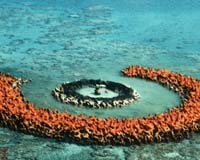
Japan has begun planting baby coral on a remote Pacific atoll in a multi-million-dollar project to save sinking islets and defend a territorial claim disputed with China, officials said Monday. Japan regards the rocky isles of Okinotori, 1,700 kilometres (1,060 miles) south of Tokyo, as the southernmost point of its territory, letting it set its 200-nautical-mile exclusive economic zone around them.
Teams will take several plants of juvenile coral to near the uninhabited isles this month after implanting six others in May, said fisheries expert Noboru Ishioka.
"We will watch the results … though it is difficult to look frequently as a voyage takes three-and-a-half days," said Ishioka, chief researcher at Fisheries Infrastructure Development Centre.
"We hope to plant tens of thousands of them from this year on," he said.
His public corporation was partially tasked with the coral-growing project by the government's Fisheries Agency.
Japan has put aside some 500 million yen (four million dollars) for the project over the two years to March 2008, according to the Fisheries Agency.
The project was launched to "grow coral and protect national land," said an agency official who declined to be named.
But another official, Akito Sato, who is in charge of the project at the agency, said Japan "cannot rule out the possibility that rising water would cover the islands," due to global warming.
"We can use coral as a means to ward off the submergence," he said, adding another reason was to protect the environment on the atoll.
Also known as Douglas Reef, the atoll, about 11 kilometres (seven miles) in circumference, has been extensively eroded by waves. Only several square metres on the tops of the two rocks, which are reinforced by concrete, remain above surface at high tide.
China has insisted Okinotori is just rocks and thus is not regarded under the UN Convention on the Law of the Sea as an entity around which Japan can set its 200-nautical-mile exclusive economic zone.
Source: Agence France-Presse
