
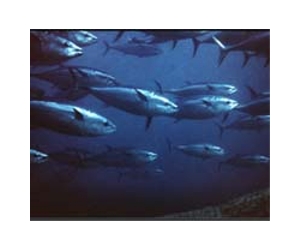
A Japanese company has started exporting what it calls sustainably grown bluefin tuna, which it says allows sushi lovers to keep eating the species without driving down ocean stocks.
Bluefin tuna is either caught in the open seas or farmed from baby fish caught in nets, but marine products company Burimy says it is the first to sell bluefin grown from artificially hatched eggs.
"Our tuna won't affect the ecological system so that we can help stop draining marine resources," said Takahiro Hama, a director of the company based in the southern Japanese city of Amakusa.
"We have just begun full shipments to the United States," he said. "We hope to provide our sustainable tuna for Japanese sushi bars and restaurants which are concerned about protests from environmental activists."
Atlantic bluefin tuna stocks have crashed in recent decades due to industrial-scale fishing, mostly for the Japanese market.
The Convention on International Trade in Endangered Species (CITES) is meeting until March 25 in Qatar and is set to vote on whether to declare the commercial trade in Atlantic bluefin a threat to the survival of the species.
Burimy has teamed up with Japan's Kinki University, which has succeeded in hatching eggs, nurturing baby fish and breeding them into fat adults in what the company says is the world's first complete cultivation cycle.
Burimy first bought 1,500 artificially hatched baby bluefin tuna from the university's A-marine Kindai laboratory in December 2007 and over the next two years grew them into 1.2-metre (four-foot) adults.
"This complete cultivation will help meet the demand of tuna-loving people without damaging the ecological balance," said Osamu Murata, chief of the project at A-marine Kindai.
"It may help the vision of bringing nature and humans into balance."
Since January, Burimy has shipped 20 fish a week to the United States.
Small amounts of fully farmed bluefin tuna, dubbed Kindai tuna, have also been sold at Japanese department stores and shops, priced at 2,000 to 4,000 yen (22 to 44 dollars) per kilogram (10 to 20 dollars per pound).
Burimy has set up five tanks measuring 40 by 40 metres that are 20 metres deep and filled with murky water to make the fast predator fish swim more slowly and avoid crashing into each other.
The company expects to ship 7,000 to 10,000 of the fish a year by 2012, targeting annual sales of one billion yen (11 million dollars).
earlier related report
Japan to fight global trade ban on Atlantic bluefin tuna
Tokyo (AFP) March 11, 2010 – Japan vowed Thursday to fight a global trade ban on Atlantic bluefin tuna, the pricey mainstay of sushi and sashimi, as Europe and the United States step up moves to protect the species.
The world's largest consumer of bluefin said it would ignore a global trade ban that could be decided this month on the species, which marine ecologists say faces the threat of extinction after decades of industrial-scale fishing.
Washington and Brussels have pledged to back a vote to list the ocean predator as endangered, alongside the panda, tiger and great apes, under the UN Convention on International Trade in Endangered Species (CITES).
Japan said Thursday it will hold firm to its position and take a "reservation," or opt out of the CITES, or Washington Convention, listing of the species as it has done for humpback and minke whales in the past.
"Basically, the Washington Convention's purpose is to protect endangered species from extinction, but I don't think bluefin tuna faces such a situation," said top government spokesman Hirofumi Hirano.
"Japan will claim its unchanged position that resource control should take place" instead of a trade ban, he said ahead of the meeting of 175 CITES member countries from Saturday until March 25 in Doha, Qatar.
Last week the Japanese vice fisheries minister, Masahiko Yamada, said that "Japan will inevitably have to take a reservation".
Under CITES rules, a country that takes a reservation on a species within 90 days of its listing "shall be treated as a state not a party to the present convention with respect to trade in the species concerned."
Elsewhere in Tokyo, at the huge Tsukiji Fish Market, Japanese tuna traders also voiced their opposition to the looming trade ban, which will require the support of two-thirds of CITES member countries.
"Protect tuna in the markets!" and "We oppose a decision at the Washington Convention" yelled fishmongers with blue headbands, punching the air with their fists, at the world's largest fish market, on Tokyo Bay.
"I don't think it's appropriate to discuss bluefin tuna in the forum for endangered species, because you can preserve the species with appropriate resource control," said Tadao Ban, president of the tuna traders' association at Tsukiji market, which moves more than 2,000 tons of seafood a day.
Bluefin tuna has sold here for as much as 175,000 dollars for a 232 kilogram (511 pound) fish. A small serving of "otoro" or fatty underbelly tuna meat can cost 2,000 yen (22 dollars) at high-end Tokyo restaurants.
Japan has argued that tuna fishing should be regulated through quotas set by other international bodies such as the Indian Ocean Tuna Commission and the Western and Central Pacific Fisheries Commission.
"Japan has accepted cuts in its quota for the catches. It's unfair to introduce a trade ban," Ban said.
Environmentalists argue that quota limits have been systematically exceeded as high-tech fishing fleets, using spotter aircraft and giant freezer ships, have reduced East Atlantic and Mediterranean bluefin stocks by 80 percent.
The Japanese tuna traders fired back and charged that the bigger threats to fish stocks are general overfishing by fleets using so-called encircling nets that indiscriminately destroy marine life.
"What's more important is to ban overfishing and the bycatch of tuna by large scale fishing vessels with encircling nets, run mostly by Chinese and Taiwanese fishermen," Ban said.
"We, the traders and the fishermen, all suffer from overfishing.
"European and American people should know that the canned tuna they consume on a daily basis comes from overfishing by these encircling net vessels for bonito. It's said that 20 to 30 percent of their haul are young tuna fish."
Share This Article With Planet Earth
