
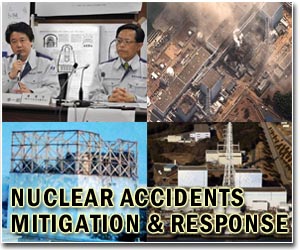
Japanese military helicopters dumped tonnes of water Thursday onto the stricken Fukushima nuclear power plant northeast of Tokyo in a bid to douse fuel rods and prevent a disastrous radiation release.
Four twin-rotor CH-47 Chinooks of the Self-Defence Forces ran the first mission to empty large buckets that hold more than seven tonnes of water each onto the facility damaged by Friday's massive earthquake and tsunami.
The operation aims to keep the fuel rods inside reactors and containment pools submerged under water, to stop them from degrading when they are exposed to air and emitting dangerous radioactive material.
The helicopter mission started in the morning under a clear sky after a similar effort the previous day was called off shortly before darkness fell by officials citing strong radiation and high winds.
Police water cannon were also set to support the effort Thursday in addition to equipment already in use over recent days at the plant, some 250 kilometres (155 miles) northeast of the Japanese capital.
Defence Minister Toshimi Kitazawa said an additional 11 military vehicles would be deployed for efforts to help cool the reactors, while pumps supplied by the US armed forces were also being transferred.
The government's nuclear safety agency has said the top priority should be pouring water into the fuel-rod pools at reactors three and four, which may be boiling and are not fully covered by roofs that would reduce radiation leaks.
An official at plant operator Tokyo Electric Power Co (TEPCO) said Thursday the pool at the number-four reactor "seemed to have water" on Wednesday, based on aerial observations carried out by the military helicopters.
Another TEPCO spokesman said: "We have not confirmed how much water was left inside but we have not had information that spent fuel rods are exposed."
TEPCO said earlier it was concentrating on restoring the power supply to reactivate its crippled cooling systems, which were knocked out in the dual calamity that hit Japan.
"We cannot tell when, but we want to restore the power source as soon as possible," TEPCO spokesman Naohiro Omura told AFP.
TEPCO was preparing to restore outside power lines from Tohoku Electric Power Co., which serves the region, and connect its damaged electric transmission system with unaffected lines.
"At the moment, we are concentrating our efforts on this work," the spokesman said.
"If the restoration work is completed, we will be able to activate various electric pumps and pour water into reactors and pools for spent nuclear fuel."
The 9.0-magnitude quake, the biggest on record to strike Japan, knocked down electricity pylons which Tohoku had used to supply power to the TEPCO plant.
Some 70 workers have been using pumps to pour seawater to cool reactors at the plant, according to media reports, using electricity from borrowed mobile generators.
In Fukushima prefecture, where a zone within 20 kilometres of the plant has already been evacuated, about 10,000 people were to be screened at 26 locations for radiation exposure, Kyodo News reported, citing local officials.
So far, radioactivity was detected on six people, whose faces and hands were wiped clean, the report said.
earlier related report
China urges 'timely, precise' Japan nuclear info
Beijing March 17, 2011 –
China on Thursday urged Japan to release "timely and precise" information on its unfolding nuclear crisis, amid growing Chinese fear of radioactive contamination from its stricken neighbour.
"We hope the Japanese side will release information, as well as its evaluation and prediction of the situation, to the public in a timely and precise manner," foreign ministry spokeswoman Jiang Yu said.
Jiang had been asked for comment on the deepening nuclear crisis in Japan, where last Friday's 9.0-magnitude earthquake and ensuing tsunami have left a nuclear power plant leaking radiation and in danger of meltdown.
Jiang did not specifically criticise any Japanese lack of openness.
But China, the United States and France have taken steps to remove their citizens from Japan despite Tokyo's assurances that the situation did not pose a major health threat outside an evacuation zone near the plant.
On Thursday, Japanese military helicopters dumped tonnes of water onto the stricken Fukushima nuclear power plant northeast of Tokyo in a frantic bid to douse fuel rods and prevent a disastrous radiation release.
"I believe that all governments and people have the right to pay great attention to this accident and Japan is exerting all-out efforts to address the situation," Jiang said.
She added that "with the increasing application of nuclear technologies we believe nuclear security is of utter importance."
China on Wednesday ordered inspections of all its nuclear facilities to reassure a jittery public and said it would temporarily suspend approvals of new Chinese projects until fresh safety rules can be formulated.
There has been growing unease in China over the Japanese crisis, with shoppers rushing to buy salt, partly in the belief the iodine it contains can help protect the body against radiation.
Share This Article With Planet Earth
