
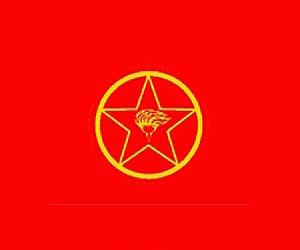
The PKK Kurdish rebel group said on Monday that its jailed leader Abdullah Ocalan held talks with the Turkish government for the first time, pro-Kurdish news agency Firat reported.
A truce declared on August 13 for the Muslim holy month of Ramadan was "the fruit of dialogue between our leader (Ocalan) and competent authorities acting in the name of the Turkish state with the knowledge of the government" in Ankara, the Kurdistan Workers' Party said in a statement.
Prime Minister Recep Tayyip Erdogan and his Justice and Development Party (AKP) on Friday denied that any dialogue had taken place with Ocalan, who was jailed for life in 1999.
The PKK said the truce was the result of an order from its jailed leader, following a spike of violence in May after Ocalan declared that he was abandoning efforts to seek dialogue with Ankara.
The statement did not specify who Ocalan negotiated with, or how the talks had taken place.
The Kurdish rebel group has called for the constitution to recognise the rights of some 15 million (out of a population of 73 million) Turkish Kurds, as well as grant autonomy to eastern and south eastern regions in Anatolia.
The PKK, listed as a terrorist group by Turkey and much of the international community, took up arms for self-rule in the Kurdish-majority south east in 1984, sparking a conflict that has claimed around 45,000 lives.
earlier related report
Iran's influence in Iraq overstated: Biden
Washington (AFP) Aug 23, 2010 –
Iran's influence in Iraq has been exaggerated and Tehran's efforts to shape parliamentary elections in the country "utterly failed," US Vice President Joe Biden said on Monday.
In a speech to veterans, Biden played down Iran's role in Iraq, defended the scaled-back US mission in Iraq and argued that the country was on the road to political stability.
"Iranian influence in Iraq is minimal. It's been greatly exaggerated," Biden told the Veterans of Foreign Wars in Indianapolis, Indiana.
"The Iranian government spent over 100 million dollars trying to affect the outcome of this last election to sway the Iraqi people, and they utterly failed," he said, referring to the March polls.
"And it's because politics and nationalism has broken out in Iraq. The Iraqi people voted for their desired candidates, none of whom, none of whom — let me emphasize this — none of whom were wanted by Iran."
Biden said that Iraqi Prime Minister Nuri al-Maliki and his rival for the premiership, Iyad Allawi, were both deemed "persona non grata" by the authorities in neighboring Iran.
US officials and some lawmakers in Congress have previously voiced concern about Iran's role in Iraq.
Biden also offered an optimistic view on the aftermath of Iraq's inconclusive March 7 general election, even though political leaders so far have failed to form a new government amid disputes over power-sharing.
He said he was optimistic about the outcome of the negotiations in Baghdad.
"This process can sometimes be frustrating and there are ups and downs, but I'm here to tell you I'm absolutely confident that Iraq will form a national unity government that will be able to sustain that country," he said.
He said that he had urged party leaders to forge an accord and "made it clear to the leading politicians that it's time for them to match the courage of their citizens by completing this process."
Responding to critics who have warned against the US troop withdrawal, Biden said that violence was at lower levels compared to four or five years ago.
"Some said that our drawdown would bring about more violence. Well, they were wrong, because the Iraqis are ready to take charge," he said.
Al-Qaeda's network in Iraq and Shiite militants still posed a threat, "but they have utterly failed to achieve their objective, which was to inflame an additional round of sectarian conflict and undermine the election that just took place and stop the formation of a new government.
"They have failed," he said.
The last US combat brigade pulled out of Iraq last week, as the US military reduces troop levels to 50,000 by September 1 under a new "advise and assist" mission laid out by President Barack Obama.
Obama, who opposed the Iraq war from the beginning and promised as a candidate to withdraw US forces as quickly as possible, has insisted the drawdown is on schedule and will not be altered.
Share This Article With Planet Earth
