
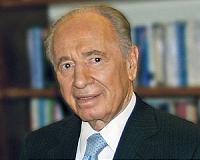
Israeli President Shimon Peres said Tuesday that Prime Minister Benjamin Netanyahu blocked a 2011 peace agreement he had secretly negotiated with Palestinian leader Mahmud Abbas.
Peres said he and Abbas had finalised a draft agreement in a series of secret meetings in neighbouring Jordan but the draft was rejected by Netanyahu's right-leaning government.
"We had gone through all of the points and the agreement was ready," Peres told Israel's Channel Two television in an interview on the occasion of Israel's independence day.
"Netanyahu told me to wait a few days because he thought that Tony Blair could get a better offer," Peres said, referring to the former British prime minister who is the envoy of the Middle East peacemaking quartet of the European Union, Russia, the United Nations and the United States.
"The days passed and there was no better offer."
It was not the first time that the secret talks between Peres and the Palestinian leader had been revealed.
In August 2011, Abbas told a meeting of his ruling Fatah movement that he had held four rounds of talks with the Israeli president, who was one of the architects of the Oslo accords of 1993 that established the Palestinian Authority.
"After the first four meetings, a fifth meeting was planned in Amman but Shimon Peres made his excuses and told me: 'I'm sorry but the government doesn't accept what we have negotiated and there's nothing more I can do'," he said.
In Israel, the post of president is largely ceremonial and executive power rests with the prime minister. Peres is to retire next month at the age of 90 after a political career spanning nearly seven decades.
His comments come with the peace process that he won the Nobel Peace prize for helping to launch in tatters after the collapse in late April of nine months of US-brokered peace talks between negotiators for Abbas and Netanyahu.
Top US officials to visit Israel this week
Washington (AFP) May 06, 2014 –
US National Security Advisor Susan Rice will visit Israel this week for high-level talks only days after the collapse of a US-led peace bid, the White House said Tuesday.
Rice will "lead the US delegation to the US-Israel Consultative Group meetings" on Wednesday and Thursday, said Caitlin Hayden, spokeswoman for the National Security Council.
It will be Rice's first trip to Israel since becoming the top security advisor to President Barack Obama in July and also comes just ahead of resumed negotiations on Iran's nuclear program.
The consultative group meets regularly for "strategic interagency consultations with senior members of the US and Israeli governments to discuss a wide range of bilateral and regional security issues."
Rice will also meet with Israeli President Shimon Peres and Prime Minister Benjamin Netanyahu, Hayden said in a statement.
The trip comes as the White House is evaluating whether to continue with its hard-fought negotiations to strike a peace deal after Netanyahu last month announced Israel was pulling out of the process.
The Israeli leader has angrily denounced moves by the Palestinian president Mahmud Abbas to strike a reconciliation deal with Hamas militants, who control the Gaza Strip.
State Department deputy spokeswoman Marie Harf Monday dismissed reports that Secretary of State John Kerry had decided to dismantle the team of negotiators who have been based on the ground in Jerusalem for months trying to push forward the Israeli-Palestinian peace process.
"We're going to see where this goes from here and, you know, figure out what makes sense in terms of staffing," she told reporters, saying "we have some senior officials that will be going soon" to the region, without going into specifics.
Chief US negotiator Martin Indyk was said to have been quoted anonymously in an interview in the Israeli daily, Yedioth Ahronoth, in which US officials blamed Israel for the breakdown in the talks and said Netanyahu "did not move more than an inch."
Harf insisted no one side was to blame, saying "both sides did things that were incredibly unhelpful."
She did confirm, however, that Kerry is mulling whether to release a document laying out some of the principles reached during the nine months of talks.
Indyk, a former US ambassador to Israel, has meanwhile returned to Washington for consultations, Harf confirmed.
