
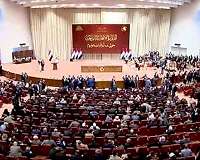
Iraqi authorities have launched an inquiry into this month's parliamentary elections after intelligence services found that the voting machines used were vulnerable to hacking.
The May 12 poll delivered a shock win for populist cleric Moqtada Sadr, who faces a huge task to form a governing coalition despite winning the most seats in parliament.
But with the results yet to be ratified by Iraq's Supreme Court, a government official told parliament on Thursday that intelligence services had conducted tests which showed it was possible to hack voting machines and manipulate the results.
The cabinet decided to form a commission "to study reports and information on the electoral process" and make recommendations, Prime Minister Haider al-Abadi said in a televised address.
Experts said the probe could lead to anything from local recounts to the entire vote being annulled.
Multiple candidates and parties are expected to appeal the results of Iraq's first poll since the defeat of the Islamic State group.
Limited recounts have already been ordered in the flashpoint multi-ethnic province of Kirkuk, where clashes between communities prompted authorities to impose an overnight curfew.
The International Crisis Group said Thursday it was "deeply concerned" about the possibility of further inter-ethnic violence there and called for a recount "to restore confidence in the institutions vital to manage deeper divisions over the contested, oil-rich area".
Twin explosions target Iraq communist party HQ: spokesman
Baghdad (AFP) May 25, 2018 –
Two bombs exploded Friday close to the Baghdad headquarters of the Iraqi Communist Party, said a spokesman for the political alliance which alongside populist cleric Moqtada Sadr triumphed in elections earlier this month.
Three people were injured in the twin explosions, a police official told AFP on condition of anonymity.
The attack is the first time a political party has been targeted in the Iraqi capital since the electoral campaign started in mid-April.
"Two bombs were thrown at the ICP headquarters," in Al-Andalus Square, spokesman Jassem al-Hilfi told AFP.
He accused the "corrupt who cannot accept that they lost" the parliamentary elections of being behind the attack.
The bombings are "a threatening message aimed at frightening us to stop us from pursuing the path of reform and change," he added.
The Iraqi Communist Party receives threats "all the time", Hilfi said.
Sadr's Marching Towards Reform anti-corruption campaign saw the alliance win 54 seats in the May 12 vote, to become the biggest bloc in Iraq's 329-seat parliament.
The pro-Iranian Conquest Alliance, made up of ex-fighters from mainly Shiite paramilitary units that battled the Islamic State group, came second in the elections.
The Victory Alliance of Prime Minister Haider al-Abadi, who declared victory over IS in December, performed worse than expected and came third.
Iraq's complex political landscape means weeks of horse-trading are likely before a new government takes shape.
The May 12 vote, the first since Iraq declared victory over the Islamic State group, was marked by record abstention levels as many voters stayed away in a rebuke to the perceived corruption of the ruling class.
IS, which seized swathes of Iraq during a lightning 2014 offensive, has lost nearly all the territory it once held but the group is still capable of carrying out sporadic attacks.
Five people were killed on Friday when an IS suicide bomber detonated his explosive belt in a park in northern Baghdad, where families had gathered for the suhur meal taken before daybreak during the holy Muslim month of Ramadan.
