
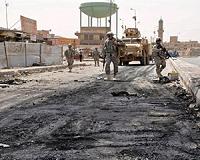
Security forces in Iraq's western region of Anbar began digging a trench around the provincial capital Ramadi Sunday to protect it against infiltrations by the Islamic State group, officials said.
The trench and berm defensive structure will be 45 kilometres (28 miles) long, protecting mostly the city's southern and western side from the vast desert of Anbar where IS has remote hideouts.
"Ambar Operations Command has begun digging a trench and building berms south of Ramadi," provincial council member Adhal al-Fahdawi told AFP.
"The purpose is to stop car bombs and other security breaches from desert regions," he said.
"The desert in Anbar is vast, it faces Saudi Arabia, Jordan and Syria and it is not fully secured. There are many canyons in which Daesh members can hide," he said, using an Arabic acronym for IS.
Iraqi forces retook Ramadi, which lies about 160 kilometres (100 miles) west of Baghdad, a year ago but IS fighters have continued to harass the security forces there.
The city, large parts of which were completely levelled in the fighting, needs to be secure if reconstruction efforts are to be stepped up.
"The main reason for this project is to prevent infiltrations by terrorists and suicide attackers and their car bombs, as well as movements by traffickers," Mahmud al-Falahi, who heads the Anbar Operations Command, said.
He said the trench and the berms would be around five-feet (1.5 metres) deep and high respectively.
Optimism on the front line over Mosul assault
Al-Buseif, Irak (AFP) Feb 19, 2017 –
In the arid hills, Iraqi forces drive their armed vehicles towards a village of around a dozen small stone houses. There is a sudden explosion. "Got it!" shouts an officer.
Just a few hundred metres (yards) from the front line of an offensive launched on Sunday at dawn to oust the Islamic State group from western Mosul, Iraqi forces casually watch the fighting.
Unperturbed by the distant blasts, some take selfies with a group of foreign journalists as others discuss their love lives over cigarettes and sandwiches.
Overhead, helicopters pound houses where the jihadists are entrenched, and along the horizon, the sky is darkened by mushrooms of rising smoke.
In the nearby village, houses now lie in ruins, some still on fire. A man runs out of one building, shouting, and is shot down by forces positioned just a few metres away.
Then a white vehicle tears out of the village.
"Watch out — car bomb!" officers shout as it disappears behind buildings.
Moments later, a huge explosion sounds in the distance, accompanied by a thick cloud of billowing smoke.
"They're desperate," says Ali, mechanically rubbing the Kalashnikov assault rifle slung over his shoulder.
– 'My first battle' –
He wears a T-shirt emblazoned with the words "We are at your service, oh Hussein" — grandson of the Prophet Mohammed and a figure highly revered by Shiite Muslims.
"They'll try to cause as many losses as possible, because they know they're going to die anyway," says his colleague Alaa, referring to the Sunni Muslim jihadists.
"This battle of Mosul is my first, and with the help of God we will rid the country of these Daesh rats," he adds, using an Arabic acronym for IS.
A senior army commander says the offensive, a new phase in a four-month-old operation on Iraq's second city, remains on track.
"We have achieved all our objectives to date. We destroyed at least two car bombs and killed more than 20 jihadists," says Abbas al-Juburi of the interior ministry's elite Rapid Response force.
The operation is backed by a US-led international coalition.
Some 750,000 civilians are estimated to be trapped in western Mosul, and with little access to basic necessities.
"The morale of the terrorist group's fighters is at its lowest," Juburi tells AFP.
Hakem Gassem Mohamad, an officer on the front line, is also optimistic that the jihadists can be defeated.
"I don't expect a very difficult fight: their end has arrived," he says.
But he does express concern about the lives of civilians in western Mosul, fearing that the jihadist group will use them as human shields.
But, he adds, "we have faced more complicated challenges. This one is easy."
