
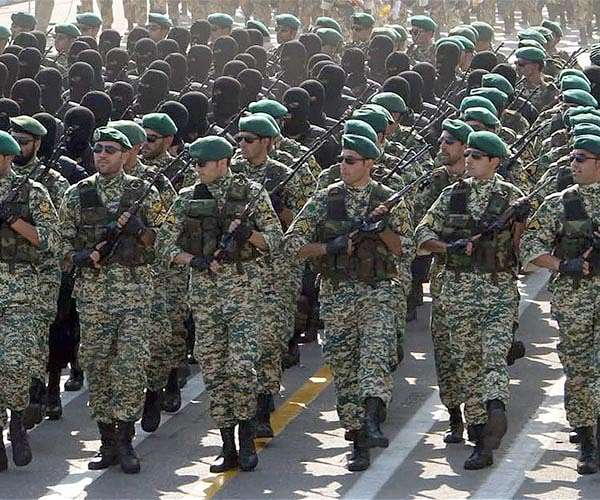
Iran's Revolutionary Guards said Thursday they would not stop avenging a top general killed in a US attack as a condition to end sanctions, a sticking point in nuclear talks.
Iran has been engaged for a year in negotiations with France, Germany, Britain, Russia and China directly, and the United States indirectly, to revive the 2015 deal, known formally as the Joint Comprehensive Plan of Action (JCPOA).
General Qasem Soleimani, who headed the Quds Force, the foreign operations arm of the Revolutionary Guards, was killed in a US drone strike in Iraq's capital Baghdad in January 2020.
"Enemies have asked us several times to give up avenging the blood of Qasem Soleimani, for the lifting of some sanctions, but this is a fantasy," Guards navy commander Rear Admiral Alireza Tangsiri said, quoted by the Guards' Sepah News website.
The Guards are the ideological arm of Iran's military.
Former US president Donald Trump ordered Soleimani killed, saying he was planning an "imminent" attack on US personnel in the Iraqi capital.
Iran responded to his assassination by firing missiles a few days later at Iraqi bases housing US soldiers, causing injuries.
In 2018, two years before Soleimani's killing, the US unilaterally withdrew from the nuclear deal and reimposed sanctions on Iran, prompting Tehran to step back from its commitments.
Negotiations in the Austrian capital Vienna aim to return Washington to the deal, including through the lifting of sanctions, and to ensure Tehran's full compliance with its commitments.
Among the key remaining sticking points is Tehran's demand to delist the Revolutionary Guards from a US terror list.
That sanction, imposed by Trump after he withdrew from the nuclear agreement, is officially separate from the atomic file.
Right-wing US politicians and Israel, the arch-rival of Iran, have warned Washington against lifting sanctions on the Guards.
Iran this week said that "technical issues" in the now-paused negotiations to restore the nuclear agreement have been resolved, but "political" issues persist ahead of concluding any deal.
"We have repeatedly stressed (to Washington) that Iran is not willing to abandon its red lines," Iranian Foreign Minister Amir-Abdollahian said Thursday, without giving further details.
On Monday, Iran's foreign ministry spokesman Saeed Khatibzadeh said "the perpetrators, officials, accomplices and advisers" in Soleimani's death "will not go unpunished", adding that "these people must be brought to justice".
Biden reluctant to remove Iran's Revolutionary Guards from terror list
Washington (AFP) April 20, 2022 –
US President Joe Biden seems increasingly determined to keep the "terrorist" designation on Iran's Revolutionary Guards, which Tehran is demanding be removed before it returns to a deal on curbing its nuclear program.
"Each side is just hoping that the other would blink first," Ali Vaez, an Iran expert from the International Crisis Group, a conflict-prevention think tank, told AFP.
Negotiations opened a year ago in Vienna to revive the landmark 2015 agreement that was supposed to prevent Iran from acquiring nuclear weapons.
Under the presidency of Donald Trump, the United States walked out of the agreement in 2018 and reinstated economic sanctions against Tehran, which in response, shrugged off restrictions imposed on its nuclear activities.
Biden wants Iran to return to the agreement, provided that Iran resumes those commitments.
Despite early hopes, the talks are deadlocked and the emissaries have not been in the Austrian capital since March 11.
However, a draft compromise is still on the table, after resolution of most of the thorniest issues.
The fate of the Guards is the final obstacle blocking the talks: the Islamic Republic is demanding the removal of its elite ideological force from the US blacklist of "foreign terrorist organizations."
– Change of direction –
The Iranians argue that it was only added to the list by Trump to increase pressure on them after the US exit from the 2015 agreement, also known by its acronym, the JCPOA.
But the Americans have shot back that the subject is in no way related to the nuclear issue.
"If Iran wants sanctions lifting that goes beyond the JCPOA, they'll need to address concerns of ours that go beyond the JCPOA," State Department spokesman Ned Price said this week.
He added that Iran should negotiate in "good faith" and reciprocity.
The United States has said it does not negotiate in public and had avoided making any clear statement on the fate of the Revolutionary Guards' status.
But Price's comments appeared to confirm that the Biden administration was hardening its position against removing the designation after a split between its diplomatic fringe, allied with part of the military, and the political wing of the White House.
The former had favored some kind of gesture toward the Guards on the grounds that dropping the group from the blacklist would have few real-world consequences, while the latter feared criticism from Republicans before the November midterm elections.
Questioned at the beginning of April, Secretary of State Antony Blinken gave a first indication of a toughening stance by saying that the Revolutionary Guards were indeed, in his eyes, a "terrorist organization."
"I'm not overly optimistic at the prospects of actually getting an agreement to conclusion," he told NBC News.
Influential Washington Post columnist David Ignatius then reported that Biden was preparing to rule out the organization's removal from the blacklist.
– 'Crucify' –
"I don't think the final decision has been taken yet, but the president is certainly leaning in that direction," said the Crisis Group's Vaez.
Vaez hopes, without harboring any illusions, that a compromise might be found by delisting the Guards while keeping their overseas branch, the Quds Force, on the blacklist.
But privately, US officials are suggesting that even such a compromise as that may no longer be on the table.
Vaez recognizes that any gesture toward Iran on such a sensitive issue "would be used by the opponents and critics to crucify the Biden administration" by denouncing its weakness in the face of such a sworn enemy of the United States.
Making matters worse, the Revolutionary Guards back other US foes — such as Hezbollah in Lebanon, or the Yemeni Huthi rebels, or even some Iraqi militias — and have been blamed for numerous attacks against US soldiers or interests in the Middle East.
Several elected officials within the president's own Democratic camp are also opposed to their removal from the blacklist.
"And that is the political cost that I think the president is reluctant to pay," said Vaez, who, however, warns that a failure to reach a deal will also exact a high political cost.
"The Republicans are bound to accuse him of allowing Iran to become a virtual nuclear weapons state under his watch now," predicted the expert.
