
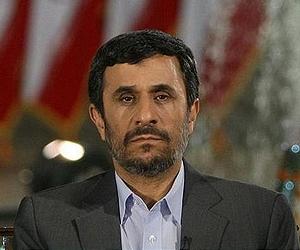
Iran's economy is feeling no ill effects from the toughest Western sanctions yet and is in fact benefiting from them, Iranian President Mahmoud Ahmadinejad told American television on Sunday.
"These sanctions will definitively mark a new level of progress in our economy," Ahmadinejad told ABC News in an interview in New York. "We have turned sanctions around and created opportunities out of this."
His assessment couldn't have differed more from that of US Secretary of State Hillary Clinton, who in a separate interview with ABC in Jerusalem praised the measures imposed by the UN Security Council in June as "biting."
"In fact the information we're getting is that the Iranian regime is quite worried about the impact on their banking system, on their economic growth because they've already encountered some tough economic times. And this is, you know, making it more costly."
Ahmadinejad insisted Iran wanted more nuclear talks with the so-called P5 plus one — permanent UN Security Council members Britain, China, France, Russia and the United States plus Germany.
Iran is suspected of planning to build a nuclear weapon, something Tehran strongly denies.
"We have a plan to discuss things, to discuss issues," Ahmadinejad told ABC. "We've always been ready to discuss issues as long as they're within the legal framework and based on principles of justice and respect."
The last high-level meeting between Iran and the six world powers was held in Geneva in October 2009 when the two sides agreed a nuclear fuel swap deal that has since stalled.
The Iranian leader said Tehran was complying fully with inspections by the UN's nuclear watchdog, the International Atomic Energy Agency (IAEA).
"All our nuclear activities are being controlled by cameras," he said. "Material that is moved is weighed, it's examined and controlled. So as far as the IAEA supervision is concern, there's no blockage of that supervision."
Asked about the "uniform" nature of the sanctions now imposed against Iran, by the United Nations, the United States, the European Union, Japan, South Korea, Russia, even China, Ahmadinejad responded: "It is meaningless to us."
"We do take sanctions seriously, but taking it seriously is different from believing that they are effective," he said.
"We consider this and have recorded it as a serious violation of international law. It was illegal. It was wrong. It wronged the people of Iran by insulting them."
Pushed further on the crippling effect the sanctions could have on businessmen trying to trade or on Iran's vital shipping industry, Ahmadinejad was defiant.
"None of this is a problem," he said. "I want to stress, it is not a problem. If you want to say it's effective, why not wait for the next six months or a year to see with your own eyes whether there are effects or not? And I tell you there are none."
earlier related report
UN chiefs presses Iran on nuclear, rights disputes
United Nations (AFP) Sept 19, 2010 –
UN chief Ban Ki-moon on Sunday gave Iran's President Mahmoud Ahmadinejad pointed reminders about international disputes over his country's nuclear drive and human rights.
Ahmadinejad met the secretary general at the UN headquarters in his first formal engagement of his trip to New York for the UN General Assembly.
With Iran already facing four rounds of UN Security Council sanctions over its refusal to halt uranium enrichment Ban "hoped that Iran will engage constructively in negotiations" with international powers on the nuclear showdown.
Ban said the talks should lead to "a mutually acceptable agreement in conformity with relevant Security Council resolutions," said a statement released by a UN spokesman.
Talks between Iran and Britain, the United States, France, Germany, China and Russia have become stalled over the nuclear program, which Western powers say is aimed at developing an atomic weapon.
Iran denies the charge though recent reports by the UN International Atomic Energy Agency have been increasingly critical of Iran's refusal to cooperate with international inspectors.
Ban also stressed to the Iranian leader "the importance of respecting fundamental civil and political rights."
Iran has faced a separate international outcry over the case of Sakineh Mohammadi-Ashtiani has been sentenced to death by stoning for adultery and also received a 10-year jail term for participating in the murder of her husband.
Many Western countries have complained at the severity of the sentence.
Ahmadinejad has given interviews with US media and has other high profile appearances planned while in New York, where he is surrounded by very tight security.
Share This Article With Planet Earth
