
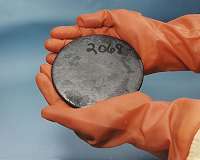
Iran announced Monday a more than tenfold increase in enriched uranium production following a series of steps back from commitments under a 2015 nuclear deal abandoned by the United States.
The Islamic republic has also developed two new advanced centrifuges, one of which is undergoing testing, Ali Akbar Salehi, the head of the Atomic Energy Organisation of Iran, announced.
Enriched uranium production has reached five kilogrammes per day, Salehi told reporters at the Natanz facility in central Iran in remarks broadcast by state television.
That compares with the level of 450 grams two months ago.
Tehran decided in May to suspend certain nuclear commitments, a year after US President Donald Trump withdrew from the deal between world powers and Iran and reimposed sanctions on the country.
Tehran has so far hit back with three packages of countermeasures and threatened to go even further if the remaining partners to the deal — Britain, China, France, Germany and Russia — fail to help it circumvent US sanctions.
After the latest announcement, the European Union warned that its support for the nuclear deal depends on Tehran fulfilling its commitments.
"We have continued to urge Iran to reverse such steps without delay and to refrain from other measures that would undermine the nuclear deal," said Maja Kocijancic, spokeswoman for EU diplomatic chief Federica Mogherini.
Although the EU "remained committed" to the accord, "we have also been consistent in saying that our commitment to the nuclear deal depends on full compliance by Iran", she told reporters in Brussels.
On July 1, Iran said it had increased its stockpile of enriched uranium to beyond a 300-kilo maximum set by the deal, and a week later, it announced it had exceeded a 3.67-percent cap on the purity of its uranium stocks.
It fired up advanced centrifuges to boost its enriched uranium stockpiles on September 7.
Salehi said Iranian engineers "have successfully built a prototype of IR-9, which is our newest machine, and also a model of a new machine called IR-s … all these in two months".
– EU deadline over –
Iran has removed all of its IR-1 centrifuges — the sole deal-approved machines — and is now using advanced models, leading to the sharp increase in enriched uranium production, he added.
"We must thank the enemy for bringing about this opportunity to show the might of the Islamic republic of Iran, especially in the nuclear industry," Salehi said.
"This is while some say (Iran's) nuclear industry was destroyed!" he said, laughing.
Iran will take the fourth step of walking back on the nuclear accord on Tuesday, semi-official news agency ISNA reported without specifying details.
The announcement came as Iranians held mass rallies four decades to the day after revolutionary students stormed the US embassy in the capital and took dozens of American diplomats and staff hostage.
Washington marked the anniversary by slapping sanctions on nine aides to Iran's supreme leader Ayatollah Ali Khamenei.
"This action further constricts the supreme leader's ability to execute his agenda of terror and oppression," Treasury Secretary Steven Mnuchin said in a statement.
It took a full 444 days for the hostage crisis to end with the release of 52 Americans, but the US broke off diplomatic relations with Iran in 1980 and ties have been frozen ever since.
Monday also marked the end of the 60-day deadline Iran gave to Europe to either provide it with the economic benefits of the nuclear agreement or see even more commitments abandoned.
The European parties to the Vienna deal have repeatedly called on Iran to stay within the accord's framework but their efforts to skirt unilateral US sanctions have so far borne no fruit.
Khamenei called French President Emmanuel Macron's efforts to set up talks between Iran and the US to break the impasse "naive".
Macron's efforts to initiate a phone call between US President Donald Trump and his Iranian counterpart Hassan Rouhani on the sidelines of the UN General Assembly in September ended in failure.
Rouhani stressed he would only hold talks with the US if sanctions were lifted first.
Iran nuclear deal: developments since US exit
Tehran (AFP) Nov 4, 2019 –
Iran's announcement Monday of a sharp increase in its enriched uranium production is another blow to the 2015 nuclear deal with world powers, which has unravelled since the United States withdrew in 2018.
Here are key developments in the bitter standoff.
– US quits –
On May 8, 2018, President Donald Trump announces the US will quit the 2015 pact and reinstate sanctions on Iran and companies with ties to it.
"We cannot prevent an Iranian nuclear bomb under the decaying and rotten structure of the current agreement," he says.
Iranian President Hassan Rouhani says he is ready to discuss with the remaining parties — Britain, China, France, Germany and Russia — ways to save the deal.
But he threatens to resume uranium enrichment if the talks fail.
– Sanctions –
In late May, US Secretary of State Mike Pompeo outlines 12 tough conditions from Washington for any "new deal". They include new nuclear commitments and a full scaling-back of Iran's regional role.
In August and November, Washington reimposes sanctions, particularly targeting Iran's oil and finance sectors.
Major international firms halt their activities or projects in Iran.
Trump in May 2019 annuls sanctions exemptions enjoyed by eight countries on Iranian oil imports.
– Progressive disengagement –
On May 8, 2019, Iran says it has decided to suspend two commitments it made under the nuclear deal.
Trump announces new measures against Iran's steel and mining sectors.
On July 1, Iran, which had so far respected its deal commitments according to the UN's nuclear watchdog the IAEA, announces it has exceeded the 300-kilogramme limit on its enriched uranium reserves.
On the 7, Tehran confirms that it has breached the accord's uranium enrichment cap of 3.67 percent.
It threatens to abandon more commitments after 60 days unless a solution is found.
A day later, it says it has enriched uranium to 4.5 percent.
– Diplomatic coup –
On August 25, Iranian Foreign Minister Mohammad Javad Zarif makes a surprise appearance on the sidelines of the G7 summit in Biarritz at the invitation of French President Emmanuel Macron.
Trump says he would be prepared to meet his Iranian counterpart Rouhani "if the circumstances were correct".
The Iranian president tells Washington to "take the first step" by lifting all sanctions.
On September 4, Rouhani tells the cabinet he does not think there will be a deal. Shortly after, the US imposes further sanctions.
– Escalation –
On September 14, a wave of aerial attacks claimed by Yemen's Iran-backed Huthi rebels sparks fires at two major Saudi oil facilities.
Tehran, which denies involvement, is accused by the United States, Saudi Arabia, Britain, France and Germany of being responsible.
The crisis revives fears of a military confrontation between the US and Iran.
It comes after Trump said in June he had approved a retaliatory strike after Iran's Revolutionary Guards shot down a US drone, but cancelled it at the last minute.
– Uranium enrichment –
On September 26, the IAEA says Iran has started using advanced models of centrifuges to enrich uranium.
Iran's supreme leader Ayatollah Ali Khamenei on November 3 again rules out negotiations with Washington.
The next day, Tehran says its enriched uranium production has reached five kilogrammes per day, a more than tenfold increase, and it has developed two new advanced centrifuges, one of which is undergoing testing.
Iran will take the fourth step of walking back on the nuclear accord on Tuesday, according to semi-official news agency ISNA.
