
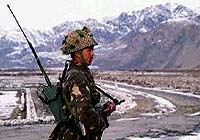
The head of India's army on Wednesday confirmed that Pakistan has redeployed troops along the two countries' tense border but said he regarded war as a "last resort."
"The aspect of some (Pakistani) troops coming towards the east… we are aware of it. That has happened. They have come to the eastern border of Pakistan with India," General Deepak Kapoor told a news conference.
"However, having known this fact, let me assure you that the Indian army has factored this in its planning," he added. "That is not something which is a cause of concern for us."
Tensions between the two nuclear-armed rivals dramatically escalated after India accused "official agencies" in Pakistan of involvement in the November 26 Mumbai attacks in which 174 people, including nine gunmen, were killed.
Pakistan has strongly denied that accusation.
Senior defence and security officials in Pakistan had said late last month that troops were being moved from the northwest tribal areas bordering Afghanistan, hotbeds of Taliban and Al-Qaeda activity, to the eastern border near India.
The chief of India's 1.3-million-strong army conceded that tensions between the two countries, who have fought three wars since their 1947 independence, were high.
He did not say if India had also bolstered its troops along the already heavily militarised border, including the tense Line of Control that divides the disputed Himalayan region of Kashmir.
"There has been a larger amount of tensions since 26/11 because we do feel that the perpetrators came from Pakistani soil," Kapoor said.
"In view of that, we in India are keeping all our options open and that must be clearly understood," the general said.
"It is not to raise any kind of hysteria for war… but I am referring to the keeping of all our options open — whether diplomatic, economic or, as the last resort, a fighting option," he said.
Pakistani foreign ministry spokesman Mohammad Sadiq said the remark that all options were open was "most unfortunate."
"Pakistan continues to make every effort to defuse tensions in South Asia and has repeatedly stated that it is prepared to extend its cooperation to the Indian government concerning the Mumbai incident," the spokesman said.
Sadiq said Islamabad regretted that India "continues to ratchet up tensions, which is certainly not helpful to the cause of peace, security and stability of the region and in the overall efforts in countering terrorism."
Also Wednesday, India's foreign minister criticised Pakistan for downplaying the significance of a dossier New Delhi compiled on the Mumbai attacks.
"The (Indian) material is adequate for Pakistan to take up a probe," Pranab Mukherjee said after the Pakistani prime minister Yousuf Raza Gilani said the dossier provided information rather than evidence.
"There is a continuing pattern of evasiveness and denial in Pakistan's response to the terrorist attack on Mumbai.
"These reinforce the already strong doubts which exist on Pakistan's stance on terrorism and on its capacity and willingness to cooperate with other countries against terrorism," he added.
Meanwhile, the US State Department said the two nations had so far managed to control tensions over the Mumbai attacks, despite the deployment of troops to their common border.
The nuclear-armed South Asian neighbours — which have fought two of their three wars since independence from Britain over Kashmir — have said they do not want to go to war again.
However, India has accused Pakistan of failing to take serious action against the alleged plotters of the Mumbai attacks, and continues to pile political and diplomatic pressure on its arch-rival.
Pakistan calls India army chief's comments 'most unfortunate'
Pakistan on Wednesday chided India for continuing to "ratchet up tensions" in the wake of the Mumbai attacks, calling its army chief's remark that all options were open "most unfortunate."
The statement from the foreign ministry in Islamabad was the latest in a series of tit-for-tat accusations between the neighbours in the six weeks since the attacks in Mumbai, which killed 174 people including nine of the gunmen.
India's army chief General Deepak Kapoor said earlier Wednesday that while he regarded war as a "last resort," the current situation meant that "we in India are keeping all our options open and that must be clearly understood."
Pakistani foreign ministry spokesman Mohammad Sadiq responded by saying "these statements are most unfortunate."
"Pakistan continues to make every effort to defuse tensions in South Asia and has repeatedly stated that it is prepared to extend its cooperation to the Indian government concerning the Mumbai incident," the spokesman said.
Sadiq said Islamabad regretted that India "continues to ratchet up tensions, which is certainly not helpful to the cause of peace, security and stability of the region and in the overall efforts in countering terrorism."
"Indulging in the blame game is counterproductive," he said.
India has pinned blame for the Mumbai attacks on the Pakistan-based militant group Lashkar-e-Taiba and said that Islamabad has not done enough to crack down on militant activity on its soil.
Islamabad has admitted that the lone surviving Mumbai gunman, who is in Indian custody, is a Pakistani national.
Prime Minister Yousuf Raza Gilani said last week that Pakistan's powerful Inter-Services Intelligence (ISI) agency had provided India with feedback about its dossier on the carnage in Mumbai.
But Gilani appeared to downplay the significance of the file on Tuesday, telling lawmakers, according to state media: "All that has been received from India is some information. I say information because these are not evidence."
Share This Article With Planet Earth
