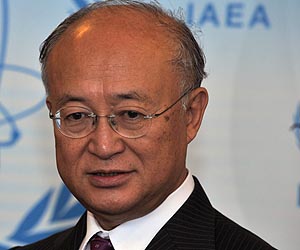
Japan's nuclear disaster dominated talks by members of the IAEA's nuclear safety convention, who vowed Thursday to take "prompt action" to apply lessons learned.
The 70-plus signatories to the Convention on Nuclear Safety said they were "committed to taking prompt actions" after a giant tsunami slammed into the Fukushima Daiichi plant on March 11.
As the CNS members wrapped up an 11-day conference vowing "to draw and act upon the lessons of the Fukushima accident," Greenpeace activists staged a protest outside saying the only lesson would be a "global phase out of nuclear energy."
The protesters set up an "evacuation zone around a steaming cooling tower symbolising nuclear power plants" outside the meeting venue, the Vienna headquarters of the International Atomic Energy Agency.
"The IAEA claims to be an independent watchdog on atomic energy, yet actively promotes nuclear power," Greenpeace charged in a statement.
Set up in 1957, the IAEA, frequently referred to as the UN's atomic watchdog, is responsible for drawing up international safety standards for nuclear power plants.
But under its mandate, it has no powers to legally enforce those standards.
The regular review conference is held every three years, but this year's event has been totally eclipsed by the world's worst nuclear accident since Chernobyl in 1986.
"The international community recognises the significance of the Fukushima nuclear accident, which highlights the need to consider new challenges and underlines the paramount importance of safety in the use of nuclear energy," the CNS countries said.
Nevertheless, it is an ongoing process "and cannot be completed until sufficient additional information is known and fully analysed. Japan has committed to provide this information as soon as possible."
During the 11 days of talks, it was the issue of nuclear power plant design that attracted most discussion among participating countries, the meeting's president, Li Ganjie of China's National Nuclear Safety Administration, told a news conference.
"We believe it is necessary to further enhance the capability to resist the external eents in terms of design and construction of the nuclear power plants and also to enhance safety standards," Li said.
"It was this issue which attracted most discussion."
In their final statement, the CNS countries said they have agreed to hold a special meeting in August 2012, specifically on Fukushima.
"The aim of (that) meeting is to enhance safety through reviewing and sharing lessons learned and actions taken by contracting parties in response to events in Fukushima and to reviewing the effectiveness and, if necessary, the continued stability of the provisions of the Convention on Nuclear Safety," they said.
Greenpeace campaigner Aslihan Tumer said: "The Fukushima and Chernobyl disasters prove that nuclear can never become a safe method of electricity production, despite the efforts of governments and the nuclear industry to play down the risks."
Share This Article With Planet Earth