
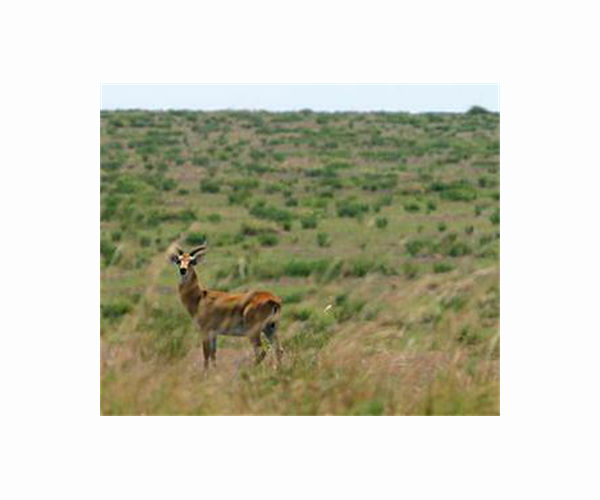
Gazelles at an Iraqi wildlife reserve are dropping dead from hunger, making them the latest victims in a country where climate change is compounding hardships after years of war.
In little over one month, the slender-horned gazelle population at the Sawa reserve in southern Iraq has plunged from 148 to 87.
Lack of funding along with a shortage of rain has deprived them of food, as the country's drought dries up lakes and leads to declining crop yields.
President Barham Saleh has warned that tackling climate change "must become a national priority for Iraq as it is an existential threat to the future of our generations to come".
The elegant animals, also known as rhim gazelles, are recognisable by their gently curved horns and sand-coloured coats. The International Union for Conservation of Nature classes the animals as endangered on its Red List.
Outside Iraq's reserves, they are mostly found in the deserts of Libya, Egypt and Algeria but are unlikely to number "more than a few hundred" there, according to the Red List.
Turki al-Jayashi, director of the Sawa reserve, said gazelle numbers there plunged by around 40 percent in just one month to the end of May.
"They no longer have a supply of food because we have not received the necessary funds" which had come from the government, Jayashi said.
Iraq's finances are under pressure after decades of war in a poverty-stricken country needing agricultural and other infrastructure upgrades.
It is grappling with corruption, a financial crisis and political deadlock which has left Iraq without a new government months after October elections.
"The climate has also strongly affected the gazelles," which lack forage in the desert-like region, Jayashi added.
– Barren soil –
At three other Iraqi reserves further north, the number of rhim gazelles has fallen by 25 percent in the past three years to 224 animals, according to an agriculture ministry official who asked to remain anonymous.
He blamed the drop at the reserves in Al-Madain near Baghdad, and in Diyala and Kirkuk on a "lack of public financing".
At the Sawa reserve, established in 2007 near the southern city of Samawah, the animals pant under the scorching sun.
The brown and barren earth is dry beyond recovery, and meagre shrubs that offer slight nourishment are dry and tough.
Some gazelles, including youngsters still without horns, nibble hay spread out on the flat ground.
Others take shelter under a metal roof, drinking water from a trough.
Summer hasn't even begun but temperatures have already hit 50 degrees Celsius (122 Fahrenheit) in parts of the country.
The effects of drought have been compounded by dramatic falls in the level of some rivers due to dams upstream and on tributaries in Turkey and Iran.
Desertification affects 39 percent of Iraqi land, the country's president has warned.
"Water scarcity negatively affects all our regions. It will lead to reduced fertility of our agricultural lands because of salination," Saleh said.
He has sent 100 million dinars (over $68,000) in an effort to help save the Sawa reserve's rhim gazelles, Jayashi said.
But the money came too late for some.
Five more have just died, their carcasses lying together on the brown earth.
Starvation tied to climate change likely killed hundreds of penguins in New Zealand
Washington DC (UPI) Jun 17, 2021 –
Hundreds of dead, small kororā penguins that washed ashore on the northern New Zealand coast appear to have starved to death and researcher point to climate change as the likely cause.
"They're just skin and bones," Graeme Taylor, a seabird scientist with the New Zealand Department of Conservation, told Radio New Zealand.
"They've got no fat on their body. They need that insulation of the fat layer to keep them warm. And they haven't got that [and] they haven't got much muscle tissue on them."
As ocean temperatures warm, small fish the penguins eat swim deeper to get to cooler waters. The small penguins can only dive to depths of 65 to 100 feet below the ocean surface.
With their main food source out of reach, hundreds of the penguins have died.
Taylor is principal science adviser at the New Zealand Department of Conservation.
According to Taylor, mass deaths of the little blue penguins used to occur roughly once every 10 years, but in six years, there have been three mass die-offs.
Taylor said La Niña, a weather event that affects the climate pattern around the world every three to five years, combined with a marine heat wave, has made it much harder for the penguins to feed.
La Niña creates a periodic cooling of ocean temperatures in the east-central Pacific around the equator but it brings warmer water to northern New Zealand.
New Zealand had its hottest year ever recorded in 2021, according to the National Institute of Water and Atmospheric Research.
