
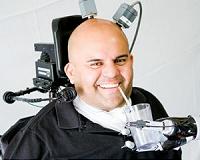
Microelectrodes implanted in the brain of a tetraplegic patient have helped scientists anticipate his intended movements so they could steer a robotic arm accordingly, a new report shows. The results tell researchers more about the neuronal activity underlying intended movements and represent an important step toward improved neuro-prosthetic devices.
Previously, scientists interested in controlling prosthetics have tried to implant chips in parts of the brain related to production of movement, but here, Tyson Aflalo and colleagues took a different course – implanting neural recording devices in the posterior parietal cortex, or PPC, a part of the brain where rapidly firing nerves contain information about planned motor activity.
The researchers analyzed neuronal activity in the PPC of a patient, known as EGS, who was paralyzed from the neck down about 12 years ago and implanted with two microelectrode arrays in 2013.
Using functional magnetic resonance imaging, Aflalo et al. monitored the patient's neurons while EGS imagined various types of limb and eye movements. Based on the neural activity they recorded, the researchers were able to predict which limbs EGS wanted to move – as well as where he wanted to move them, when, and how fast.
This information was then used to steer a computer cursor or to direct a robotic arm situated beside EGS to the intended location. The researchers also observed that EGS could alter the activity of neuron populations simply by imagining different motor actions.
The results build upon previous research in both monkeys and humans, suggesting that the PPC is involved with planned actions as well as more abstract concepts such as goals and intentions.
The results bring scientists a step closer to making brain control of a robotic limb or computing device a reality. A Perspective article by Andrew Pruszynski and Jorn Diedrichsen describes these findings and their implications in greater detail.
