
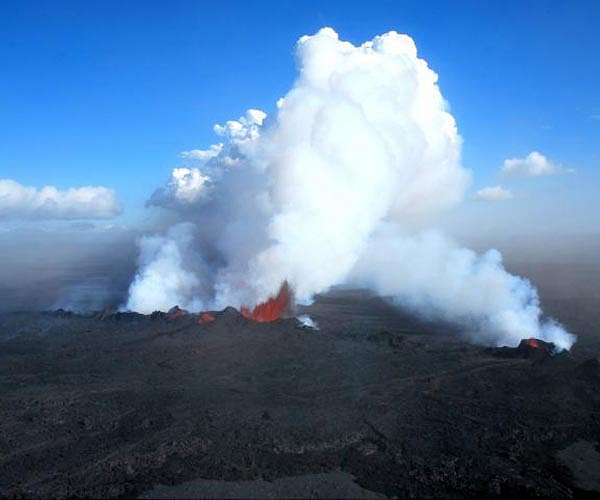
A volcano that spewed glowing red lava near Iceland's capital Reykjavik after awakening for the first time in 900 years appeared to be subsiding on Saturday, posing no danger to people, experts said.
Streams of red lava bubbled and flowed out of a fissure in a valley in Geldingadalur, close to Mount Fagradalsfjall on the Reykjanes peninsula in southwestern Iceland.
As the lava flow slowed under rain showers on Saturday, a blue gas plume and a vapour cloud rose from the site, just 40 kilometres (25 miles) from the capital and near a popular tourist destination, the Blue Lagoon geothermal spa.
The eruption occurred on Friday around 2045 GMT, lighting up the night sky with a crimson glow as hundreds of small earthquakes shook the area.
While Iceland's Keflavik International Airport and the small fishing port of Grindavik are just a few kilometres away, the zone is uninhabited and the eruption did not present any danger to the public.
"The eruption is considered small at this stage and the volcanic activity has somewhat decreased since yesterday evening," the Icelandic Meteorological Office (IMO), which monitors seismic activity, said in a statement on Saturday.
It said the "eruptive fissure" measured approximately 500 to 700 metres (1,640 to 2,300 feet).
The lava area, it added, was less than one square kilometre (0.4 square mile), with small lava fountains.
Speaking to reporters, University of Iceland geophysicist Magnus Tumi Gudmundsson described the valley as an "ideal" spot for the eruption, likening it to "a bathtub the lava can slowly leak into."
IMO earthquake hazards coordinator Kristin Jonsdottir meanwhile said it was "very likely the eruption will last for the next few days".
Friday's eruption took place in the Krysuvik volcanic system, which does not have a central volcano, about five kilometres inland from the southern coast.
Sigurdur Kristmundsson, a 54-year-old Grindavik port official, told AFP that locals were exhilarated by the eruption.
"Nobody is in danger or anything like that. So I think people are excited and not afraid of it."
– Dormant for 900 years –
Access to the area was initially blocked off but later opened to the public, though Iceland's Department of Civil Protection and Emergency Management stressed the several-hour hike from the nearest road was only recommended for those "used to being outdoors in difficult conditions."
Gases from a volcanic eruption — especially sulphur dioxide — can be elevated in the immediate vicinity, and may pose a danger to health and even be fatal.
Gas pollution can also be carried by the wind.
"Currently gas pollution is not expected to cause much discomfort for people except close up to the source of the eruption. The gas emissions will be monitored closely," the IMO said.
The Krysuvik system has been inactive for the past 900 years, according to the IMO, while the last eruption on the Reykjanes peninsula dates back almost 800 years and lasted about 30 years, from 1210 to 1240.
But the region had been under increased surveillance for several weeks after a 5.7-magnitude earthquake was registered on February 24 near Mount Keilir on the outskirts of Reykjavik.
Since then more than 50,000 smaller tremors had been registered, and magma was detected just one kilometre under the Earth's surface in recent days near Fagradalsfjall.
Geophysicist Gudmundsson said the eruption signalled a new period "which may last centuries with eruptions, possibly 10 years to 100 years apart."
– Land of fire and ice –
Iceland has 32 volcanic systems currently considered active, the highest number in Europe. The country has had an eruption every five years on average.
The vast island near the Arctic Circle straddles the Mid-Atlantic Ridge, a crack on the ocean floor separating the Eurasian and North American tectonic plates.
The shifting of these plates is in part responsible for Iceland's intense volcanic activity.
The most recent eruption was at Holuhraun, beginning in August 2014 and ending in February 2015, in the Bardarbunga volcanic system in an uninhabited area in the centre of the island.
That eruption did not cause any major disruptions outside the immediate vicinity.
But in 2010, an eruption at the Eyjafjallajokull volcano sent huge clouds of smoke and ash into the atmosphere, disrupting air traffic for more than a week and cancelling more than 100,000 flights worldwide, which left some 10 million passengers stranded.
Icelandic volcano erupts, lighting up night sky near Reykjavik
Reykjavik (AFP) March 20, 2021 –
A volcano erupted just 40 kilometres (25 miles) from Iceland's capital Reykjavik on Friday, with red lava spewing out of the ground and a crimson glow lighting up the night sky as a no-fly zone was established in the area.
"Volcanic eruption has begun in Fagradalsfjall. Flight colour code is red but very little turbulence is seen on seismometers," Iceland's Meteorological Office (IMO), which monitors seismic activity, wrote on Twitter.
Streams of red lava could be seen flowing out of a fissure in the ground in video footage filmed by a coast guard helicopter and posted by the IMO on its Facebook page.
"The fissure is estimated to be about 200 metres (219 yards) long," the IMO wrote.
Police and coast guard officials raced to the scene late Friday, but the public has been advised to stay away from the area.
The Krysuvik volcanic system, which does not have a central volcano, is located south of Mount Fagradalsfjall on the Reykjanes peninsula in southwestern Iceland.
"The first notification was received by the Meteorological Office at 2140 GMT. The eruption was confirmed through webcams and satellite images," the institute said on its website.
While Iceland's Keflavik International Airport and the small fishing port of Grindavik are just a few kilometres away, the area is uninhabited and the eruption was not expected to present any danger.
Volcanic eruptions in the region are known as effusive eruptions, where lava flows steadily out of the ground, as opposed to explosive ones which spew ash clouds high into the sky.
The Krysuvik volcanic system has been inactive for the past 900 years, according to the IMO, while the last eruption on the Reykjanes peninsula dates back almost 800 years, to 1240.
But the region has been under increased surveillance for several weeks after a 5.7-magnitude earthquake was registered on February 24 near Mount Keilir on the outskirts of Reykjavik.
That quake has since been followed by an unusual number of smaller tremors — more than 50,000, the highest number since digital recordings began in 1991.
The seismic activity has moved several kilometres southwest since the quake, concentrating around Mount Fagradalsfjall, where magma was detected just one kilometre under the Earth's surface in recent days.
Gas emissions from both types of volcanoes — especially sulphur dioxide — can be elevated in the immediate vicinity of an eruption, and may pose a danger to health and even be fatal.
Further away, the pollution can exceed acceptable limits depending on the winds.
The gas "can cause problems, troubles, and negative health effects," the Environment Agency of Iceland said.
– Land of fire and ice –
Iceland has 32 volcanic systems currently considered active, the highest number in Europe. The country has had an eruption every five years on average.
The vast island near the Arctic Circle straddles the Mid-Atlantic Ridge, a crack on the ocean floor separating the Eurasian and North American tectonic plates.
The shifting of these plates is in part responsible for Iceland's intense volcanic activity.
The most recent eruption was at Holuhraun, beginning in August 2014 and ending in February 2015, in the Bardarbunga volcanic system in an uninhabited area in the centre of the island.
That eruption did not cause any major disruptions outside the immediate vicinity.
But in 2010, an eruption at the Eyjafjallajokull volcano sent huge clouds of smoke and ash into the atmosphere, disrupting air traffic for more than a week with the cancellation of more than 100,000 flights worldwide which left some 10 million passengers stranded.
