
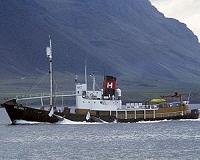
Iceland has protested at a five-nation accord to ban unregulated fishing around the North Pole and says it will not be bound by the deal.
The foreign ministry in Reykjavik on Thursday hauled in the ambassadors of the five countries that sealed the July 16 agreement — the United States, Russia, Canada, Denmark on behalf of Greenland, and Norway.
Iceland — which did not take part — "is… not bound by this declaration," the government said in a statement.
"Climate change and the warming of the oceans mean that international waters in the Arctic may in the near future become accessible for fishing," the statement said.
"The management and arrangement of such fisheries are of great concern for Iceland, which largely bases its earnings on marine resources," it added.
"Iceland emphasises that its scientific knowledge and fishing experience can contribute significantly to consultations and discussions in this field."
The agreement prohibits commercial fishing in a 2.8-million-square-kilometre (1.1-million-square-mile) area in the rapidly-melting waters around the North Pole.
The five countries fear the waters could be plundered by commercial operators in the absence of international regulation.
In 2012, more than 2,000 scientists called for an international fisheries agreement to protect the waters, where a number of studies have predicted sea ice could disappear completely over the summer in the coming decades.
According to estimates cited by the US-based Pew Research Center, 40 percent of the international part of the Arctic Ocean, also known as the Central Arctic Ocean, was ice-free in September 2012 when the ice melted to a record low.
The Central Arctic Ocean is surrounded by so-called economic zones belonging to the five countries that signed the agreement.
A small part of it is already regulated by the North East Atlantic Fisheries Commission.
