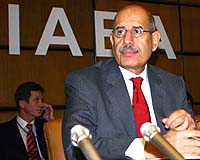
UN nuclear watchdog chief Mohamed ElBaradei warned Tuesday that the agency would not be in a position to respond to a nuclear emergency like Chernobyl if member states did not increase its funding.
In tough-talking comments to the International Atomic Energy Agency's 35-member board during a budget debate here, ElBaradei said that if the watchdog did not have adequate funding "if we have an accident tomorrow, we will not be able to fulfil our responsibilities."
The final decision lay in the hands of the member states, the IAEA chief insisted.
"At the end of the day, it's your budget. If you come to me and say you'll cut there and there, then it's your budget," ElBaradei told the closed-door session. AFP obtained a recording of his remarks.
But countries had to be clear about the implications of such a move, he warned.
"I and my colleagues will not assume any responsibility (if) in a couple of years from now, we see another Chernobyl, or a nuclear terrorist."
ElBaradei is asking its 145 member states for a major cash boost over the next two years: an 11-percent rise in funding for 2010 plus a further 1.5-percent hike in 2011.
The nuclear watchdog estimates it needs 336 million euros for its day-to-day operations next year, up from around 300 million euros in 2009. That figure was expected to rise to 341 million euros in 2011.
The United States is the single biggest contributor to the IAEA, followed by Japan and Germany.
US President Barack Obama has called for funding to be doubled over the next four years, while other countries, such as Germany, are pushing for zero budget growth.
ElBaradei has long argued the IAEA is underfunded as it needs more manpower and equipment to cope with a growing interest in nuclear energy technology worldwide, and the increased proliferation concerns connected with that.
But pushing through the proposals could be tough at a time of global economic crisis.
It has been proposed that IAEA borrow money to cover the extra funding.
But such a mechanism would threaten the agency's work in the long term, ElBaradei warned.
"The whole idea that either we have to borrow or stretch out our hand … is really a bastardisation of an international organisation," he said.
Share This Article With Planet Earth